Citizenship in Nepal 2026: Types, Eligibility & Process
A 2026 (2083 BS) practitioner's pillar guide to citizenship in Nepal — the constitutional framework under Arti...
Read more →
Alpine Law Associates is the leading full-service law firm encompassing a wide range of legal practices located in Kathmandu, Nepal. It consists of a team of the country's best lawyers, each with expertise in their respective fields, tailored to meet clients' specific needs.
Anamnagar-29, Kathmandu


Most Nepalis who took foreign citizenship — for work, study, marriage, or family reunification — discover the NRN regime only when they need to inherit Nepal property, open a foreign-currency account, or skip visa lines on their next visit home. See our immigration-law practice area for related matters.
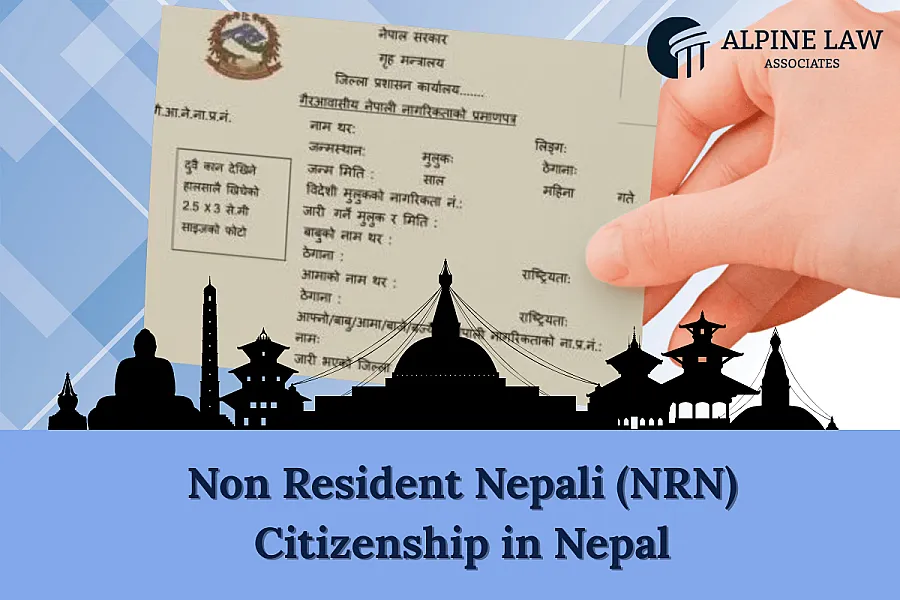
NRN citizenship in Nepal is not full Nepali citizenship — it is a special diaspora status under the Non-Resident Nepali Act 2064 (2008) that grants economic, social, and cultural rights but stops short of political rights, the right to vote, public office, and a Nepali passport.
Below is the working framework our diaspora-advisory team uses with NRN clients in the United States, United Kingdom, Australia, the Gulf, and Europe — the two categories of NRN, the eligibility rules, the DAO and embassy application paths, the NRN ID card, and exactly which rights it does and does not unlock.
NRN citizenship in Nepal is the special diaspora status under the Non-Resident Nepali Act 2064 and Rules 2066. Two categories qualify — a "Foreign Citizen of Nepalese Origin" (a person of Nepali ancestry who has acquired non-SAARC foreign citizenship) and a "Nepali Citizen Residing Abroad" (a Nepali citizen living in a non-SAARC country for at least two years). Both must hold a valid NRN ID card to claim NRN rights. SAARC countries are excluded under both categories. The card is issued by the Ministry of Foreign Affairs in Kathmandu, the District Administration Office (DAO), or Nepali embassies abroad. NRN status grants economic, social, and cultural rights — including property purchase, foreign-currency banking, and a 10-year visa — but excludes voting, public office, and a Nepali passport.
Alpine Law Associates — trusted by 1,000+ clients across family, corporate, civil, and criminal cases in Nepal.
Speak with our lawyers today →
Our diaspora-advisory team handles NRN ID applications, renewals, and the downstream filings the card unlocks — property purchases, ancestral inheritance, foreign-currency investment, and family-side citizenship questions for foreign-born children of NRN parents. The most frequent friction we see is a client who confuses NRN citizenship with full Nepali citizenship and is surprised the card does not produce a passport, or who skips the NRN ID and tries to claim NRN rights on a foreign passport alone. As a full-service law firm in Nepal, we sequence the DAO or embassy filing, manage the renewal cycle, and align the NRN status with the underlying property, business, or family-law transaction.
NRN citizenship is a constitutionally authorised special diaspora status — distinct from, and far narrower than, full Nepali citizenship. It exists to give the Nepali diaspora rooted abroad a formal legal connection to Nepal without forcing them to renounce their adopted country's citizenship.
The status is created by the Non-Resident Nepali Act 2064 (2008 AD), enabled by Article 14(1) of the Constitution of Nepal 2072 which permits the state to grant NRN status, and operationalised through the Non-Resident Nepali Rules 2066 (2009 AD).
Three things distinguish NRN citizenship from regular Nepali citizenship:
| Feature | Full Nepali Citizenship | NRN Citizenship |
|---|---|---|
| Document | Citizenship certificate | NRN ID card |
| Voting in Nepal elections | Yes | No |
| Public office / civil service | Yes | No |
| Nepali passport | Yes | No |
| Property in Nepal | Unrestricted | Permitted within ropani caps |
| Foreign-currency account | Limited under NRB rules | Permitted |
| Visa requirement to enter Nepal | None | 10-year free visa for NRN ID holders |
| Issuing authority | District Administration Office | MoFA + DAO + Nepali embassies abroad |
For the full Nepali citizenship framework — types, eligibility, application — see our citizenship in Nepal guide. For the property-rights side that NRN status unlocks, see our NRN property rights guide.
Key takeaway: NRN status is a partial-rights diaspora category, not full citizenship. Treating it as a passport substitute is the most expensive misunderstanding in NRN cases.
The NRN Act 2064 recognises two distinct NRN categories. Eligibility, documentation, and downstream rights all depend on which category applies:
| Category | Definition | Eligibility |
|---|---|---|
| FCNO — Foreign Citizen of Nepalese Origin | A person who, or whose father, mother, grandfather, or grandmother, was a Nepali citizen, and who has acquired non-SAARC foreign citizenship | Non-SAARC foreign citizenship + documented Nepali ancestry up to grandparent |
| NCRA — Nepali Citizen Residing Abroad | A Nepali citizen who has been residing in a non-SAARC foreign country for at least 2 years engaged in profession, occupation, business, or employment | Active Nepali citizenship + 2+ years non-SAARC residence (excluding diplomatic missions and students) |
SAARC countries — India, Pakistan, Bangladesh, Sri Lanka, Bhutan, Maldives, Afghanistan — are excluded under both categories, reflecting the open-border arrangement with India and bilateral arrangements with the rest of South Asia. Diplomatic-mission staff and students are also excluded under NCRA because their non-Nepal residence is on government assignment, not independent diaspora.
| Provision | Role |
|---|---|
| Constitution of Nepal 2072 — Article 14(1) | Permits the state to grant NRN identity to Nepali diaspora |
| Non-Resident Nepali Act 2064 (2008) | Defines NRN, identity card issuance, rights, restrictions |
| Non-Resident Nepali Rules 2066 (2009) | Operational rules — application format, documents, fees |
| Section 2 of Act 2064 | Definitions including FCNO and NCRA |
| Section 7 of Act 2064 | Issuance of identity card to qualifying NRNs |
| Sections 9–10 of Act 2064 | Rights granted — economic, social, cultural; political rights expressly excluded |
| Sections 12–14 of Act 2064 | Property, investment, repatriation rights |
The Act and Rules are published officially at the Nepal Law Commission portal; the official NRN information page is hosted by the Ministry of Foreign Affairs.
Document requirements vary slightly by category, but the core set:
| Document | FCNO Applicant | NCRA Applicant |
|---|---|---|
| Passport (foreign for FCNO; Nepali for NCRA) | Yes | Yes (Nepali) |
| Foreign citizenship certificate | Yes | No |
| Nepali citizenship certificate | Of original Nepali ancestor (parent / grandparent) | Own Nepali citizenship |
| Proof of Nepali ancestry (lineage) | Birth certificates linking ancestor | Not required (already a Nepali citizen) |
| Renunciation evidence (where Nepali citizenship was renounced) | Yes if previously Nepali | N/A |
| Proof of 2-year non-SAARC residence | N/A | Visa, work permit, residence permit, employment letter |
| Recent passport-size photographs | Yes | Yes |
| Application form (prescribed under Rules 2066) | Yes | Yes |
| Filing fee | Yes — varies by category and authority | Yes |
| Nata kayam / relationship certificate | For ancestry verification — see nata kayam guide | N/A |
Cross-border documents (foreign citizenship certificate, foreign birth certificate) often need apostille or embassy attestation before being accepted in Nepal. For applicants applying through Nepali embassies abroad, the embassy itself can attest most local documents.
Three routes exist depending on where the applicant is and which category applies. The MoFA and DAO routes are typically used by applicants visiting or based in Nepal; the embassy route serves diaspora abroad.
Key takeaway: for most diaspora applicants, the embassy route is the practical default. The DAO route is faster and more reliable when the applicant or their representative can be physically present in the original-citizenship district.
The NRN ID card unlocks a defined set of economic, social, and cultural rights under Sections 9-14 of Act 2064:
For the property-rights deep dive see our NRN property rights guide.
Key takeaway: the NRN ID card is the gateway document — most downstream rights flow from it. Without a valid card, NRN status under Act 2064 cannot be exercised, even by an objectively qualifying person.
Equally important is what NRN status does not grant. Common misconceptions cleared:
| Often Assumed | Reality |
|---|---|
| NRN ID = Nepali passport | NO — NRN ID does not produce a Nepali passport |
| NRN can vote in Nepal elections | NO — voting is reserved for full Nepali citizens |
| NRN can hold public office | NO — no civil service, judiciary, military, or elected position |
| NRN ID converts to dual citizenship | NO — Nepal does not currently permit dual citizenship |
| NRN ID renews automatically | NO — renewal is required at the prescribed interval with current documents |
| NRN can buy unlimited land | NO — capped at 10 ropanis urban / 20 ropanis rural for fresh purchase |
| NRN can buy agricultural land freely | NO — restricted; usually requires special approval |
For the full Nepali-citizenship pathway (which would grant the rights NRN status excludes), see our citizenship in Nepal guide.
The NRN ID is not a one-time issuance — it has a validity period prescribed under the Rules and must be renewed before expiry. Renewal typically requires:
Letting the card expire is treated similarly to never holding one — downstream rights (property, banking, visa) suspend until the card is renewed or reissued. Plan renewal at least 2-3 months before expiry, particularly for diaspora applicants relying on embassy-side processing.
From our diaspora-advisory desk, the recurring errors:
Key takeaway: NRN applications fail more often on documentation than on merit. Get the ancestry / residence proof in order, get foreign documents apostilled, and pick the right route (DAO vs MoFA vs embassy) for your circumstances.
These are the questions our diaspora-advisory team is asked most often during NRN consultations from clients abroad:
No. Nepal does not currently permit dual citizenship. NRN citizenship under Act 2064 is a special diaspora status — distinct from full Nepali citizenship and distinct from dual citizenship. An NRN ID holder retains their foreign citizenship and gains specified rights in Nepal, but does not acquire Nepali political rights, voting, or a Nepali passport. Discussions about formal dual citizenship surface periodically in Parliament, but as of April 2026, no such regime is in force.
No. Act 2064 explicitly excludes SAARC-country citizens — India, Pakistan, Bangladesh, Sri Lanka, Bhutan, Maldives, Afghanistan — from both NRN categories. Indian citizens of Nepali descent must rely on the open-border arrangement and bilateral treaty rights, which differ from NRN rights and do not provide an NRN ID card.
Three routes — at the District Administration Office (DAO) of the district where original Nepali citizenship was issued, at the Ministry of Foreign Affairs in Kathmandu, or at a Nepali embassy or mission in your country of residence. The DAO route typically takes 10 to 12 working days for clean files; the embassy route 2 to 4 weeks. The DAO route is faster but requires presence in Nepal; the embassy route serves the diaspora abroad.
No, not separately. The NRN ID card itself functions as a 10-year multiple-entry visa to Nepal valid for the duration of the card. NRN ID holders can visit, stay, and leave Nepal without a separate visa fee or visa application throughout the card's validity. This is one of the most-used practical benefits of NRN status.
Not automatically. Each generation must independently qualify and apply. A foreign-born child of an NRN parent will be FCNO-eligible if the parent or grandparent was a Nepali citizen and the child has acquired non-SAARC foreign citizenship. The child must apply with their own documentation; the parent's NRN ID does not extend to them.
NRN citizenship in Nepal is the diaspora's bridge document — a special status under the Non-Resident Nepali Act 2064 that connects foreign-citizen Nepalis and long-term-abroad Nepali citizens to economic, social, and cultural rights in Nepal without requiring them to renounce their foreign citizenship. The Constitution of Nepal 2072 (Article 14) authorises the regime, and the Ministry of Foreign Affairs together with District Administration Offices and Nepali embassies abroad operate the issuance.
For diaspora applicants, the practical lessons are three: identify the correct category (FCNO or NCRA), pick the right route (DAO vs MoFA vs embassy) for where you live, and remember that NRN citizenship is partial-rights status — property, banking, visa, investment, yes; voting, public office, passport, no. Treating it as full citizenship is the single most common misunderstanding that costs applicants downstream.
For end-to-end help with NRN ID applications, renewals, ancestry-documentation reconstruction, embassy-side filing, downstream property and inheritance work, and family-side citizenship questions for foreign-born children of NRN parents, speak with our lawyers today → — Alpine Law Associates is a full-service law firm in Kathmandu with a dedicated NRN advisory team handling clients in the United States, the United Kingdom, Australia, the Gulf, and Europe.
Last reviewed: April 2026
NRN citizenship is a special diaspora status under the Non-Resident Nepali Act 2064. It grants economic, social, and cultural rights to foreign-citizen Nepalis and long-term-abroad Nepali citizens, but excludes voting, public office, and the right to a Nepali passport.
Two categories qualify — Foreign Citizen of Nepalese Origin (a person whose self, parent, or grandparent was Nepali and who now holds non-SAARC citizenship), and Nepali Citizen Residing Abroad (a Nepali citizen living in a non-SAARC country for 2+ years for work or business). Both must hold a valid NRN ID card.
Three routes — at the DAO of the district where original Nepali citizenship was issued, at the Ministry of Foreign Affairs in Kathmandu, or at a Nepali embassy abroad. DAO route typically takes 10-12 working days; embassy route 2-4 weeks. Documentation includes passport, citizenship certificates, ancestry proof, and the prescribed application form.
No. Nepal does not currently permit dual citizenship. NRN status is a partial-rights diaspora category granting economic, social, and cultural rights — distinct from both full Nepali citizenship and dual citizenship. Holders retain their foreign citizenship and gain Nepali rights specified in the NRN Act 2064.
No. The NRN Act 2064 explicitly excludes SAARC-country citizens (India, Pakistan, Bangladesh, Sri Lanka, Bhutan, Maldives, Afghanistan). Citizens of these countries with Nepali descent must rely on the open-border arrangement and bilateral treaty rights, which differ from NRN status and do not provide an NRN ID.
No. The NRN ID card does not produce a Nepali passport. NRN status grants property, banking, investment, and 10-year visa rights, but excludes the right to a Nepali passport, voting in elections, and any civil-service or elected position. A Nepali passport requires full Nepali citizenship.
No. Voting in Nepal elections is reserved for full Nepali citizens. NRN status under Act 2064 explicitly excludes political and administrative rights. NRN ID holders cannot vote, contest elections, hold public office, or serve in any government capacity.
The NRN ID card has a prescribed validity period under the NRN Rules 2066 and must be renewed before expiry. Letting the card expire suspends downstream rights — property, banking, 10-year visa — until renewal. Plan renewal 2-3 months before expiry, especially for diaspora applicants relying on embassy processing.
Yes, with limits. NRN ID holders can purchase residential and commercial property up to 10 ropanis in urban areas and 20 ropanis in rural areas. Inheritance and partition shares are not subject to the cap. Agricultural land is restricted unless specially permitted. See our NRN property rights guide for the full framework.
Apply at the Nepali embassy in Washington DC for the United States, or the Nepali embassy in London for the United Kingdom. Both embassies routinely process NRN ID applications. Documentation includes US/UK passport, foreign-citizenship certificate, original Nepali ancestry proof, photographs, and the prescribed NRN application form.
Not automatically. Each generation must independently qualify and apply. A foreign-born child of an NRN parent will be FCNO-eligible if the parent or grandparent was a Nepali citizen and the child has acquired non-SAARC foreign citizenship. The child applies with their own documentation; the parent's NRN ID does not extend to them.
No, not separately. The NRN ID card itself functions as a 10-year multiple-entry visa to Nepal for the duration of the card. NRN ID holders can visit, stay, and leave Nepal without a separate visa fee or visa application throughout the card's validity. This is one of the most-used practical benefits of NRN status.
Yes. NRN ID holders may open foreign-currency accounts in Nepali commercial banks under Nepal Rastra Bank circulars. They can hold investments in convertible foreign currency, repatriate profits and capital gains, and access NRN-specific savings and investment schemes. The NRN ID is the gateway document for these banking privileges.
Required documents include the original Nepali citizenship certificate of the parent or grandparent (the Nepali ancestor), birth certificates linking the applicant to that ancestor, and often a nata kayam (relationship certificate) issued by the Ward Office or District Court. Foreign-issued documents typically need apostille or embassy attestation before submission in Nepal.
The DAO route in Nepal typically takes 10 to 12 working days for clean files with all documentation in order. The embassy route abroad takes 2 to 4 weeks for straightforward cases, longer where MoFA-side verification is required. Applications with missing or unverified ancestry documents take longer regardless of route.
The Ministry of Foreign Affairs through the Department of Consular Services issues NRN cards in Nepal. Outside Nepal, Nepali Embassies and Missions issue cards under MoFA delegation. The Department of Immigration coordinates the entry / exit interface for cardholders. The Non-Resident Nepali Association (NRNA) provides coordination and advisory support but is not itself the issuing authority — issuance always remains with MoFA.
NRN identity cards are typically issued with 10-year validity and are renewable. Renewal is a simpler process than initial issuance, requiring proof of continued NRN status (foreign citizenship or Nepali-citizen-living-abroad documentation). Apply for renewal at least 3 months before expiry to avoid lapses; an expired card may need a fresh application with full documentation.
NRN status under the NRN Act 2064 is a special diaspora identity granting economic / social / cultural rights but stopping short of political rights, voting, public office, and a Nepali passport. Naturalisation under Article 13 of the Constitution and Section 5 of the Citizenship Act 2063 is a full Nepali citizenship grant available to foreign spouses of Nepali citizens and limited other categories. NRN is the diaspora pathway; naturalisation is the full-citizenship pathway. Most foreign-citizen NRNs choose NRN status because it preserves the foreign passport.
Yes. NRN identity card holders are entitled under Nepal Rastra Bank directives to operate foreign-currency convertible (FCY) accounts in major Nepali commercial banks. These accounts receive foreign-currency remittances and convertible income, and the balances are freely repatriable. The NRN Investment account is used for inward investment in Nepali shares and instruments. See our NRN tax filing guide for the bank-account-tax interface.
Yes. NRN investments in priority sectors (IT, manufacturing, agro-processing, tourism, hydropower) can qualify for incentives under the Foreign Investment and Technology Transfer Act (FITTA) 2075 (2019) — tax holidays, reduced corporate rates, customs concessions, and easier repatriation. The NRN identity card and FITTA investment registration together open the incentive framework. For specific sector advice, engage counsel before structuring the investment vehicle.
Under the NRN Act 2064, Nepali citizens residing in SAARC countries (India, Pakistan, Bangladesh, Sri Lanka, Bhutan, Maldives, Afghanistan) are excluded from the "Nepali citizen living abroad" NRN category. The rationale is that intra-SAARC movement, particularly Nepal-India, is governed by separate treaty arrangements. SAARC-resident Nepalis retain their full Nepali citizenship and do not need (or qualify for) NRN identity. Foreign citizens of Nepali origin in SAARC countries may still qualify for NRN status under the foreign-citizen category.
Yes — critically. Under Section 433 of the Civil Code 2074, where a foreigner acquires a share of property through partition or inheritance in Nepal, that property cannot be registered in their name. This restriction is explicitly relaxed for NRN identity-card holders. A foreign citizen of Nepali origin who has secured NRN status can inherit ancestral property (including agricultural land) and register it at the Land Revenue Office. See our NRN property rights guide for the inheritance procedure.
Children of NRN parents can apply for Nepali citizenship by descent under Article 11(2) of the Constitution where at least one parent was a Nepali citizen at the time of the child's birth. The 2079 First Amendment to the Citizenship Act 2063 strengthened the maternal-line pathway for children born abroad to Nepali mothers. Foreign-born children of NRN parents apply through the DAO with the foreign birth certificate (apostilled / consular-legalised), parent's prior citizenship documents, and standard descent documentation.
The former NRN may re-acquire Nepali citizenship through naturalisation under Article 13 of the Constitution and Section 5 of the Citizenship Act 2063. The application requires evidence of prior Nepali citizenship, foreign-citizenship renunciation evidence, residency proof, and the prescribed Government fee. Re-acquisition is discretionary and not automatic. Property and other rights held under NRN status remain protected during the transition; counsel coordinates the renunciation timing with property and tax structuring.
Yes. Alpine Law Associates handles end-to-end NRN identity work — eligibility assessment for both categories (Nepali-citizen-abroad and foreign-citizen of Nepali origin), document preparation including ancestry verification, MoFA / DAO / Embassy application coordination, NRN card renewal, FCY account setup advisory, FITTA investment structuring, and the broader NRN workstream (property, tax, inheritance, divorce). Speak with our lawyers today →
Disclaimer:
This article is intended solely for informational purposes and should not be interpreted as legal advice, advertisement, solicitation, or personal communication from the firm or its members. Neither the firm nor its members assume any responsibility for actions taken based on the information contained herein.