
Consumer Protection Law in Nepal 2026: Rights & Remedies
"The Consumer Protection Act 2075 (2018) replaced the 1998 Act. It codifies nine consumer rights, sets penalti...
Read more →
Alpine Law Associates is the leading full-service law firm encompassing a wide range of legal practices located in Kathmandu, Nepal. It consists of a team of the country's best lawyers, each with expertise in their respective fields, tailored to meet clients' specific needs.
Anamnagar-29, Kathmandu


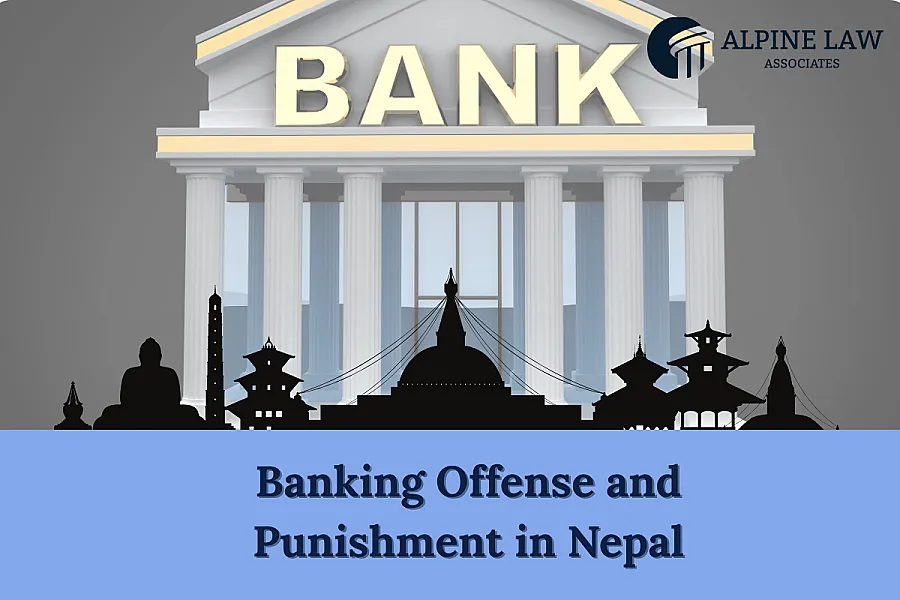
The Banking Offence and Punishment Act 2064 (2008) is the law that turns banking misconduct into a state crime in Nepal. It covers the things that erode trust in the banking system — opening accounts on false documents, drawing cheques with no balance, misusing cards, fraudulent loans, diverting a sanctioned loan, and insiders abusing a bank's resources. A 2073 (2016) amendment widened the offences and raised the penalties, so the law is tougher than older summaries suggest.
This is the 2026 (2082/83 BS) guide to the Banking Offence and Punishment Act 2064 — what counts as a banking offence, how it is punished, who investigates and prosecutes, the time limit to file, and how it overlaps with a bounced cheque. For the cheque side, see our cheque bounce case in Nepal guide; for the credit consequence, our blacklisting process guide.
Quick answer — Banking Offence and Punishment Act 2064:
Alpine Law Associates — trusted by 1,000+ clients across family, corporate, civil, and criminal cases in Nepal.
Speak with our lawyers today →
Our legal team handles banking-offence matters from both sides — for banks and creditors pursuing a fraud or dishonoured cheque, and for individuals and officers facing prosecution. The recurring misunderstanding is that this is a private dispute; it is not. Once it is a banking offence, the Government is the plaintiff and the clock under the one-year limitation starts running, which is why early advice matters.
The Banking Offence and Punishment Act 2064 (2008) is the statute that defines banking offences and their punishment in Nepal, enacted to protect trust in the banking system and reduce risks from misconduct in bank and financial-institution transactions. It applies within Nepal and to banking offences committed in Nepal by persons or institutions abroad. A Second Amendment in 2073 (2016) broadened the offences and increased the penalties, so the current law is the amended version.
The Act lists offences across Sections 3 to 14: opening an account or operating one on false or fictitious details, drawing a cheque knowing the account lacks sufficient balance, making unauthorised withdrawals or transfers from another's account, misusing credit, debit or ATM cards, obtaining loans through false financials or over-valued and double-pledged collateral, diverting a loan from its sanctioned purpose, and the abuse of a bank's resources by its directors, officers or staff.
Under Section 15, punishment is tied to the amount involved: the offender generally has to repay the claimed amount and serve imprisonment that rises in brackets as the sum increases, with the heaviest terms for the largest amounts. Loan and false-valuation offences attract a fine measured against the collateral value plus imprisonment. The 2073 amendment increased these brackets, so the exact current terms should be confirmed against the amended Act.
A banking offence is a state crime, so the police investigate on a complaint or First Information Report, and the Government of Nepal — through the Government Attorney — is the plaintiff, not the bank or the individual victim. The case is heard by a District Court designated for banking offences by notice in the Nepal Gazette, and Nepal Rastra Bank sits behind the framework as the banking regulator. The investigating officer has statutory powers during the inquiry.
Under Section 17, a First Information Report must be lodged within one year of the offence coming to knowledge, and the case must be filed in court within six months of the FIR. There is an exception where a bank or financial-institution employee or office-bearer has misappropriated the institution's assets — no time bar applies in that situation. Because the one-year clock can run quietly, a victim or institution should act on a suspected offence promptly.
A cheque drawn knowing the account lacks sufficient balance is itself a banking offence under Section 3(c) of this Act, so cheque dishonour with dishonest intent is prosecuted through the banking-offence route as a state crime rather than as a private debt claim. Following a 2025 amendment that channelled cheque dishonour into the banking-offence framework, this Act is now central to a bounced-cheque case — see our dedicated cheque bounce guide.
As soon as a banking offence is suspected — on either side. For a bank or victim, a lawyer assesses whether the conduct is a banking offence, builds the complaint and evidence, and lodges the FIR within the one-year limit. For an accused person or officer, a lawyer advises on exposure, the investigation and the defence before the case reaches court. Because the limitation runs quietly and the State drives the prosecution, timing is decisive. To discuss a matter, speak with our lawyers today.
Last reviewed: May 2026
It is the Nepali statute that defines banking offences and their punishment, in force since 2008 and amended in 2073 (2016) to widen the offences and raise the penalties.
The police investigate and the Government of Nepal is the plaintiff; the case is heard by a designated District Court. It is a state crime, not a private suit.
An FIR must be lodged within one year of the offence coming to knowledge, and the case filed within six months of the FIR, under Section 17.
The Act lists offences across Sections 3 to 14, including opening or operating an account on false or fictitious details, drawing a cheque knowing the account lacks sufficient balance, unauthorised withdrawals or transfers from another's account, misuse of credit, debit or ATM cards, obtaining loans through false financials or over-valued and double-pledged collateral, diverting a loan from its sanctioned purpose, and abuse of a bank's resources by directors, officers or staff.
Under Section 15, punishment is tied to the amount involved — the offender generally repays the claimed amount and serves imprisonment that rises in brackets as the sum increases, with the heaviest terms for the largest amounts. Loan and false-valuation offences attract a fine measured against the collateral value plus imprisonment. The 2073 amendment increased these brackets, so the exact current terms should be confirmed against the amended Act.
Yes. A Second Amendment in 2073 (2016) widened the scope of the Act — adding offences such as fraudulent activities against banks, illegal banking transactions and unauthorised collective deposit schemes (dhukuti) — and increased the penalties. This is why older summaries that cite a maximum of around five years' imprisonment understate the current position. For any specific offence, the amended text governs, so the current Act rather than the original 2064 version should be relied on.
Yes. Drawing a cheque knowing the account does not have sufficient balance is a banking offence under Section 3(c) of the Act, treated as a state crime where dishonest intent is involved, rather than as a simple private debt. Following a 2025 amendment that channelled cheque dishonour into the banking-offence framework, this is now the central route for a bounced-cheque case in Nepal. The detailed procedure is in our dedicated cheque-bounce guide.
A complaint or First Information Report about a banking offence is typically lodged with the police, who investigate, after which the Government of Nepal prosecutes as plaintiff. A bank, financial institution or affected person can set the process in motion by reporting the offence, but the prosecution itself is conducted by the State through the Government Attorney. So the victim's role is to report promptly and assist the investigation rather than to run the case privately.
Banking-offence cases are heard by a District Court designated for that purpose by notice in the Nepal Gazette. Because the offence is a state crime prosecuted by the Government, it follows the criminal-trial process rather than a civil suit. The designation of specific District Courts is intended to channel these cases for consistent handling. The exact court for a given case depends on the gazetted designation and jurisdiction, which a lawyer confirms when the case is filed.
Obtaining a loan through false financial statements, an artificial business, over-valued collateral, double-pledged security or amounts beyond the sanctioned limit is an offence under Section 7, and false valuation under Section 13, attracting a fine measured against the collateral or amount involved together with imprisonment. As with other offences, the punishment scales with the sum involved and was increased by the 2073 amendment, so the current brackets should be confirmed against the amended Act before relying on a figure.
Yes. Section 9 specifically targets the abuse or unauthorised use of a bank's resources and assets by its promoters, directors, chief executive, employees and their relatives, recognising that insider misconduct is a major banking risk. For such misappropriation by an employee or office-bearer, the Act also removes the usual time bar on filing, reflecting how serious insider abuse is treated. So bank insiders are squarely within the Act's reach, not just outsiders dealing with the bank.
No. While the general rule under Section 17 requires an FIR within one year of the offence coming to knowledge and the case within six months thereafter, the Act creates an exception where a bank or financial-institution employee or office-bearer has misappropriated the institution's assets — in that situation no time limitation applies. This means insider misappropriation can be pursued even after a long period, which is an important protection for banks against internal fraud discovered late.
Historically a dishonoured cheque could be pursued as a private claim under the Negotiable Instruments Act 2034 or as a banking offence under this Act. A 2025 amendment channelled cheque dishonour into the banking-offence framework, making this Act the central route, with the Government as plaintiff, a one-year FIR limit and criminal punishment rather than a private recovery suit. Because the position changed recently, the current cheque-bounce procedure should be confirmed — our cheque-bounce guide sets it out.
Yes, indirectly. The conduct behind a banking offence — loan default, fraud, dishonoured cheques — is also the kind of conduct that leads a bank to report a borrower to the Credit Information Bureau for blacklisting, which blocks new credit across the financial system. So a person can face both the criminal banking-offence process and the credit consequence of blacklisting at the same time. Our blacklisting-process guide explains that separate credit-side mechanism in detail.
Nepal Rastra Bank is the regulator of banks and financial institutions and sits behind the banking-offence framework — it licenses and supervises the institutions whose transactions the Act protects, and its definitions and oversight inform what is a bank or financial institution for the Act's purposes. The criminal investigation and prosecution itself, however, run through the police and the Government Attorney, with the courts deciding the case. So NRB is the regulator, not the prosecutor.
A central feature of the Act is recovery — an offender is generally required to repay the claimed amount in addition to serving the imprisonment that applies to the offence, so the punishment combines a custodial element with restitution of the sum involved. For loan and valuation offences the fine is measured against the collateral or amount. This recovery focus is why the amount involved drives both the fine and the length of imprisonment under the graded scheme in Section 15.
The Act applies within Nepal and also reaches persons or institutions who, although abroad, committed a banking offence in Nepal, reflecting that banking transactions can cross borders. This extra-territorial reach means a person cannot necessarily escape liability simply by being outside the country when the consequences land. The practical application depends on the facts and on enforcement cooperation, so anyone facing a cross-border banking-offence question should take specific advice on jurisdiction.
The Act addresses not only completed offences but also attempts and abetment, with a reduced punishment — broadly half of the punishment for the completed offence — for someone who attempts or assists a banking offence without it being fully carried out. This ensures that helping or trying to commit banking fraud is itself punishable, not just the finished act. The precise treatment depends on the offence and the facts, so the amended Act and advice should be checked for a specific situation.
Whether a banking-offence accused is granted bail or held in custody during investigation and trial depends on the offence, the amount involved and the court's assessment under the criminal-procedure framework, as the investigating officer has custody powers during the inquiry. Because the seriousness and the sum involved affect both the punishment bracket and custody decisions, bail outcomes vary case to case. An accused should take immediate legal advice, as custody and bail are decided early in the process.
As soon as a banking offence is suspected, on either side. For a bank or victim, a lawyer assesses whether the conduct is a banking offence, builds the complaint and evidence, and lodges the FIR within the one-year limit. For an accused person or officer, a lawyer advises on exposure, the investigation and the defence before the case reaches court. Because the limitation runs quietly and the State drives the prosecution, acting early is decisive to the outcome.
Disclaimer:
This article is intended solely for informational purposes and should not be interpreted as legal advice, advertisement, solicitation, or personal communication from the firm or its members. Neither the firm nor its members assume any responsibility for actions taken based on the information contained herein.