
Abortion Law in Nepal (2026): Safe Motherhood Act 2075 Guide
A 2026 practitioner's guide to abortion law in Nepal under the Safe Motherhood and Reproductive Health Rights...
Read more →
Alpine Law Associates is the leading full-service law firm encompassing a wide range of legal practices located in Kathmandu, Nepal. It consists of a team of the country's best lawyers, each with expertise in their respective fields, tailored to meet clients' specific needs.
Anamnagar-29, Kathmandu


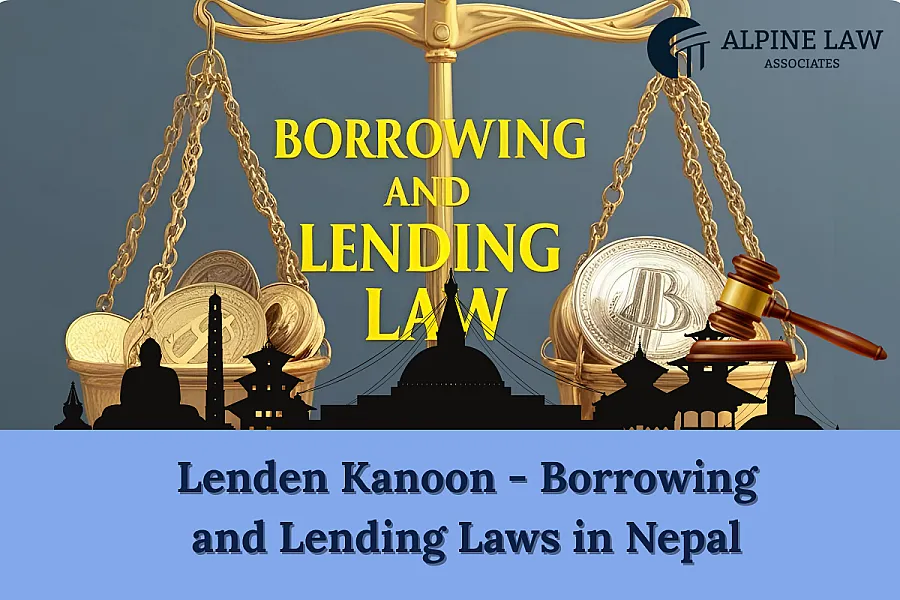
Borrowing and lending in Nepal sit on two parallel legal tracks. The first is the Muluki Civil Code 2074 (2017), in force since 17 August 2018, which governs private loans between individuals and any lending outside a licensed financial institution — the Tamasuk on a friend's loan, the family advance to a relative, the inter-company informal credit. The second is the Nepal Rastra Bank (NRB) regulatory framework — BAFIA 2073, NRB directives, and the Insolvency Act — which governs lending by commercial banks, development banks, finance companies, microfinance institutions and cooperatives. The two frameworks share principles but differ on interest ceilings, recovery routes, and prudential supervision. See Alpine's business-law practice area for related matters.
This 2026 (2083 BS) guide covers what every borrower and lender in Nepal needs to know: the Civil Code 2074 lending provisions including Section 478 on interest and the critical Section 481 cap that total cumulative interest cannot exceed the principal; the Tamasuk loan deed and the documentation that makes a loan enforceable; secured versus unsecured lending through pledge, mortgage and hypothecation; the 10-year limitation period for loan recovery; the regulatory layer for licensed lenders under NRB; civil-suit recovery routes at the District Court; cheque-bounce as a parallel recovery weapon under the Penal Code; and the foreign-currency loan framework requiring NRB approval.
Quick answer — Borrowing and lending law in Nepal (2026):
Alpine Law Associates — Nepal Bar Council-registered banking and recovery team handling loan drafting, Tamasuk attestation, secured-creditor enforcement, cheque-bounce litigation and civil recovery suits at District Courts across Nepal.
Speak with our lawyers today →
Borrowing and lending in Nepal covers any transaction where one party (the lender) transfers money or fungible goods to another party (the borrower) on the understanding that the borrower will return an equivalent amount, with or without interest, at a future time. The Muluki Civil Code 2074 treats lending as a named contract type and devotes a chapter to its core obligations — Sections 476 onwards govern interest, repayment terms, security, limitation and remedies on default. Outside the Civil Code, the BAFIA 2073 regulates licensed banks and financial institutions, the Cooperatives Act regulates cooperative lending, and NRB directives operate as the prudential supervisory layer for everyone in the licensed sector.
The distinction between private lending and licensed lending matters at every step. A private lender under the Civil Code is bound by the Section 481 interest cap and the 10-year recovery limitation, but is free to set its own interest rate by agreement; a licensed lender under NRB regulation may charge interest at rates set by its own product schedule (subject to NRB ceilings and floor rates), enforces security under specialised statutes (Secured Transaction Act, BAFIA), and operates under capital adequacy, exposure-limit and prudential rules. Borrowing from a friend and borrowing from a commercial bank look similar economically but live in entirely different legal frameworks.
The Civil Code 2074 deals with interest in two pieces. Section 478 establishes that a lender may charge "benefit interest" on the loan, with the rate set by the parties' agreement. There is no statutory floor or ceiling rate in Section 478 itself — practitioners report that the industry-standard rate for unsecured personal loans in Nepal hovers around 10 percent per annum, but this is a market norm, not a statutory cap. Parties remain free to negotiate higher or lower rates in the Tamasuk; what they cannot do is breach the Section 481 ceiling.
Section 481 is the critical statutory cap: the total cumulative interest payable on a loan cannot exceed the principal amount. Once the lender has received interest equal to the original principal, no further interest is collectable, even if the loan remains outstanding. This rule — sometimes called "principal once over" — is the borrower-protection backbone of Nepali private lending. It means a lender who lends NPR 1,000,000 cannot collect more than NPR 1,000,000 in cumulative interest, regardless of how long the loan runs unpaid. The cap operates independently of the agreed rate; high-rate loans hit the cap faster, low-rate loans hit it later, but every private loan eventually reaches the ceiling if left unpaid.
Compound interest is generally not permitted on personal / consumer loans under the Civil Code. The lender's interest accrues only on the unpaid principal, not on accumulated unpaid interest. Where lenders attempt to compound interest in the Tamasuk, courts strike down the compounding provision and recompute interest on simple basis. The compound-interest rule is one of several places where Civil Code lending diverges from licensed banking practice — banks operate compound interest on overdue accounts under separate NRB-sanctioned product structures.
Tamasuk is the Nepali term for a written loan acknowledgement signed by the borrower in favour of the lender. While a loan can be made orally and is still legally valid, a written Tamasuk is the practical gateway to enforcement — without documentary evidence, the lender faces an evidentiary uphill battle at the District Court. The Tamasuk should record the parties, the principal amount, the interest rate, the repayment schedule, the security if any, and the witnesses. For an in-depth treatment of the document itself, see our dedicated guide to Tamasuk in Nepal.
Best-practice Tamasuk drafting includes: full names and citizenship numbers of both parties; the principal amount in words and figures; the interest rate per annum (subject to the Section 481 cap); the repayment date or schedule; the consequences of default (acceleration, additional interest within statutory limits); the security or guarantor details; signatures of borrower, lender and two witnesses; and where land or significant value is involved, notarial attestation. Some lenders also take a post-dated cheque from the borrower for the full loan amount — bounce of that cheque on the due date opens a parallel criminal route under the Penal Code Section 484, in addition to the civil recovery suit.
Unsecured loans rely entirely on the borrower's personal credit and the documentary trail; on default, the lender's only route is a civil money suit at the District Court. Secured loans add a property layer — the lender holds a security interest over identified property of the borrower (or a third-party security provider), giving the lender priority over unsecured creditors and a faster enforcement route.
Three security modes operate under Nepali law:
The choice of security depends on the asset type, the loan size and the enforcement comfort of the lender. Gold pledge gives the fastest and cleanest recovery; immovable mortgage gives the highest security but the slowest enforcement; hypothecation gives operational continuity to the borrower but the highest enforcement friction.
Nepali law sets a 10-year limitation period for filing a recovery suit on a loan. The clock starts on the date the loan falls due — not the date of execution of the Tamasuk. Where the loan is repayable on demand, the clock starts when the lender first makes a demand and the borrower fails to pay. Where the loan has a fixed maturity date, the clock starts on that date. After 10 years, the lender's right to file a recovery suit is barred regardless of the merits.
Several events can reset or extend the limitation clock. A written acknowledgement of the debt by the borrower (a fresh undertaking, a part-payment receipt acknowledging the balance, a written request for extension) restarts the clock from the date of acknowledgement. A part-payment by the borrower also restarts the clock — every payment is treated as a fresh acknowledgement. Lenders running long outstanding loans should obtain a written acknowledgement every few years to keep the recovery option alive; lenders who let the loan sit unacknowledged for the full 10 years lose the suit window.
Banks, development banks, finance companies and microfinance institutions licensed by Nepal Rastra Bank operate under a different framework. The Bank and Financial Institutions Act 2073 (BAFIA), the NRB Act, and a stack of NRB directives govern: minimum and maximum interest rates on different product categories; capital adequacy under Basel norms; exposure limits to single borrowers and connected groups; provisioning for non-performing loans; and prudential reporting. Cooperatives are regulated separately under the Cooperatives Act and the Department of Cooperatives, with NRB supervisory overlay for systemically large cooperatives.
Interest in the licensed-lender sector is set by each institution's published product schedule, within ceilings and floors set periodically by NRB. Spread restrictions (the maximum gap between deposit and lending rates) operate as a prudential ceiling on lending rates. The Section 481 "principal once over" cap does not strictly apply to licensed lenders in the same statutory form, because licensed lending operates under specialised statutes that override Civil Code defaults; in practice, NRB-imposed rate ceilings and the limited tenure of most bank loans keep cumulative interest well below the principal.
When a private loan goes into default, the lender's primary recovery route is a civil money suit at the District Court of the place where the borrower resides or where the cause of action arose. The pre-suit steps that matter are: a written demand and notice to the borrower (preserves limitation, evidences the breach, opens settlement); collection and proof of the Tamasuk and any acknowledgements; interest computation up to the Section 481 cap; court-fee calculation on the principal-plus-interest claim. The suit pleads the loan, the default, the demand and the relief — typically a money decree for principal, capped interest, and costs.
Once decreed, enforcement runs through the court's execution process: attachment of the borrower's bank accounts, attachment and auction of movable and immovable property, garnishment of salary or trade receivables. Where security exists, enforcement against the security follows the security-specific procedure (auction of pledge after notice, court-supervised auction of mortgaged immovable, repossession of hypothecated movable). Licensed lenders enforce security under the Secured Transaction Act and BAFIA, generally faster than the Civil Code route. For severely distressed corporate borrowers, the Insolvency Act 2063 offers a restructuring or liquidation route, with secured creditors having priority on their security and unsecured creditors ranking pari passu in the residue.
Where the lender holds a cheque from the borrower (either issued at the time of the loan or as a post-dated repayment instrument), dishonour of that cheque on presentation opens a parallel route under the Penal Code Section 484. The standard process is: present the cheque at the borrower's bank, obtain the bounce memo recording the reason for dishonour, issue a 35-day notice to the borrower demanding payment, and on continued default, file a criminal complaint at the District Court. Cheque-bounce is a criminal offence in Nepal punishable by imprisonment and fine — the threat of criminal proceedings is a strong recovery lever, often producing settlement before the case progresses. For the full procedure, see our dedicated guide to cheque-bounce cases in Nepal.
Best practice for lenders is to take a post-dated cheque at the time of issuing the loan for the full repayment amount. The cheque adds a second weapon to the civil recovery route — a defaulting borrower facing both a civil suit and a criminal cheque-bounce complaint settles faster than one facing only a civil suit. The two proceedings can run in parallel; settlement of one does not automatically settle the other unless the parties expressly agree.
Lending and borrowing in foreign currency is restricted in Nepal under the Foreign Exchange Regulation Act and NRB directives. A Nepali resident cannot freely borrow in foreign currency from a non-resident lender, or freely lend in foreign currency to a non-resident borrower, without prior NRB approval. The approval process scrutinises the purpose, the borrower's repayment capacity, the interest rate (subject to LIBOR / SOFR-linked ceilings), and the security. External commercial borrowings (ECBs) by Nepali corporates are a specific approval category, with NRB issuing approval letters specifying the permitted tenor, rate cap and repayment route.
Repayment routing also requires NRB clearance — funds leaving Nepal as principal or interest repayment to a foreign lender must be remitted through a licensed bank with supporting NRB approval documentation. Informal foreign-currency lending (hundi, hawala-style channels) is unlawful and exposes both parties to criminal and regulatory consequences under the foreign-exchange and anti-money-laundering framework.
Alpine Law Associates provides full-spectrum borrowing and lending support. On the lender side, we draft enforceable Tamasuk and loan agreements, structure security through pledge / mortgage / hypothecation, advise on the Section 481 interest cap and compute capped interest, run civil recovery suits at the District Court, file cheque-bounce criminal complaints under Penal Code Section 484, and enforce decrees through attachment and auction. On the borrower side, we review loan agreements for usurious provisions and Section 481 compliance, negotiate restructuring and settlement, defend recovery suits where the loan documentation is defective, and represent corporate borrowers in insolvency proceedings.
For licensed-lender clients, we advise on NRB compliance, secured-transaction registration under the Secured Transaction Act, BAFIA enforcement actions, and Insolvency Act proceedings. For foreign-currency lending, we run the NRB approval workflow and structure the documentation to satisfy the foreign-exchange framework. As a full-service law firm in Nepal, we coordinate lending engagements with related contract and dispute work in a single counsel relationship.
Speak with our lawyers today →
Last reviewed: April 2026
The Muluki Civil Code 2074 (2017) governs private borrowing and lending between individuals and any lending outside a licensed financial institution. The Bank and Financial Institutions Act 2073 (BAFIA) and Nepal Rastra Bank directives govern lending by commercial banks, development banks, finance companies and microfinance institutions. The Civil Code came into force on 17 August 2018.
Civil Code 2074 Section 478 does not fix a statutory maximum interest rate — the parties set the rate by agreement in the Tamasuk. Industry practice for unsecured personal loans is around 10 percent per annum, but this is a market norm, not a legal cap. The hard statutory cap is Section 481, which says total cumulative interest collected cannot exceed the principal amount of the loan.
Section 481 of the Civil Code 2074 caps cumulative interest at the principal amount of the loan. Once the lender has received total interest equal to the original principal, no further interest is collectable, regardless of how long the loan remains outstanding. This "principal once over" rule is the borrower-protection backbone of Nepali private lending.
Compound interest is generally not permitted on personal and consumer loans under the Civil Code 2074. Interest accrues only on the unpaid principal, not on accumulated unpaid interest. Where lenders attempt to compound interest in the Tamasuk, courts strike down the compounding provision and recompute interest on a simple basis. Licensed banks operate compound interest on overdue accounts under separate NRB-sanctioned product structures.
Tamasuk is the Nepali term for a written loan acknowledgement signed by the borrower in favour of the lender. It records the parties, principal amount, interest rate, repayment schedule, security if any, and witnesses. While oral loans are legally valid, a written Tamasuk is the practical gateway to enforcement at the District Court — without it, the lender faces an evidentiary uphill battle.
10 years from the date the loan falls due. For loans with a fixed maturity date, the clock starts on that date; for loans repayable on demand, the clock starts when the lender first makes a demand and the borrower fails to pay. Written acknowledgement of the debt or part-payment by the borrower restarts the clock.
Pledge is a security over movable property where possession transfers to the lender (e.g. gold loan). Mortgage is a registered charge over immovable property where the borrower retains possession (land or building). Hypothecation is a registered charge over movable property without possession transfer (vehicles, machinery, inventory). Each has its own enforcement procedure under the Civil Code or the Secured Transaction Act.
Foreign-currency lending in Nepal requires Nepal Rastra Bank approval under the Foreign Exchange Regulation Act and NRB directives. A Nepali resident cannot freely borrow from or lend to a non-resident in foreign currency without prior NRB approval. External commercial borrowings (ECBs) by Nepali corporates are a specific approval category with prescribed tenor, rate cap and repayment routing.
The lender issues a written demand notice, then files a civil money suit at the District Court of the borrower's residence within 10 years of default. On decree, enforcement runs through attachment of bank accounts, auction of movable and immovable property, and garnishment of salary or trade receivables. If the lender holds a cheque from the borrower, a parallel cheque-bounce criminal complaint runs under Penal Code Section 484.
Witnesses are not statutorily mandatory for a Tamasuk to be valid but are best practice for enforcement. Two adult witnesses, with their names, addresses and signatures on the deed, materially strengthen the evidentiary value of the document at the District Court. For large loans or loans backed by property, notarial attestation adds further enforceability.
For pledge of movables, the lender can sell the pledged property after giving notice to the borrower, without a court order. For mortgage of immovable property, court-supervised auction is required — direct sale by the lender is not permitted under the Civil Code framework. Licensed lenders enforce hypothecation and mortgage under the Secured Transaction Act and BAFIA, which provide faster non-judicial enforcement routes.
A guarantor under Civil Code 2074 is liable for the borrower's obligation on default, jointly and severally unless the guarantee is expressly limited. The lender can sue the guarantor directly without first exhausting remedies against the borrower, unless the guarantee specifies a "benefit of discussion" clause. After paying the lender, the guarantor has a right of recourse against the borrower for the full amount paid.
No. Once the lender has received cumulative interest equal to the original principal, Section 481 prohibits any further interest collection on that loan. Even if the principal remains unpaid, no additional interest accrues. The borrower is liable only for the unpaid principal balance from that point onwards.
The two proceedings run in parallel. Present the cheque, obtain the bounce memo, issue a 35-day notice to the borrower, and on continued default file a criminal complaint at the District Court under Penal Code Section 484. The civil suit pursues the money judgment; the criminal complaint adds pressure through the prospect of imprisonment. Settlement of one does not automatically settle the other unless the parties expressly agree.
Yes, oral loans are legally valid under the Civil Code 2074 — there is no statutory requirement of writing for a loan to be enforceable. However, without a written Tamasuk, the lender must prove the loan through other evidence: witness testimony, bank transfer records, conduct of the parties, partial repayments. The evidentiary burden is much heavier without the written deed, and many oral-loan claims fail for want of proof.
Private lending is governed by the Civil Code 2074, with the Section 481 cap on cumulative interest and the 10-year limitation. Bank lending is governed by BAFIA, NRB directives and the Secured Transaction Act, with prudential ceilings on rates rather than the cumulative cap, prescribed product structures, and specialised non-judicial enforcement routes. The frameworks differ on interest, recovery and prudential supervision.
Under the Civil Code 2074, the borrower can repay a loan early; the lender cannot refuse early repayment unless the contract specifies a lock-in period. Interest accrues only up to the date of actual repayment, not for the full original tenure. Licensed banks may charge prepayment penalties under their product schedule, subject to NRB-prescribed ceilings on prepayment fees for consumer loans.
The lender should keep the signed Tamasuk with witness signatures, copies of borrower citizenship and PAN, the cheque (if taken as security), photographs of any pledged property, the security registration certificate for mortgages and hypothecations, bank transfer records evidencing the loan disbursement, all correspondence and demand notices, and a contemporaneous interest computation sheet. Strong documentation materially shortens the recovery suit timeline.
A written acknowledgement of the debt by the borrower after default — a fresh undertaking, a part-payment receipt acknowledging the balance, a written request for extension — restarts the 10-year limitation clock from the date of acknowledgement. Lenders running long outstanding loans should obtain a written acknowledgement every few years to keep the recovery window alive.
Processing or service fees are generally permitted under the Civil Code 2074 if explicitly agreed in the Tamasuk and reasonable in amount. Excessive fees that effectively raise the cost of borrowing beyond the Section 481 cumulative cap are unenforceable; courts treat such fees as disguised interest. Licensed lenders charge product-specific fees under NRB-approved schedules.
Yes. Microfinance institutions are NRB-licensed under BAFIA Class D and operate under specific NRB directives covering interest ceilings (typically 15 percent per annum on group loans), loan-size limits, eligible borrower categories, and reporting. Microfinance is not Civil Code private lending — it is part of the licensed-lender framework with its own product, prudential and enforcement rules.
On default, the lender files a recovery suit at the District Court attaching the Tamasuk, the registered mortgage deed and the demand notice. On decree, the court orders auction of the mortgaged property; the auction is conducted under the court's supervision with public notice. Sale proceeds first satisfy the mortgage debt, then unsecured creditors, with any surplus returning to the borrower. Licensed lenders enforce under the Secured Transaction Act with faster non-judicial routes.
The borrower's liability passes to the legal heirs to the extent of the estate inherited. Heirs are not personally liable beyond the value of the inherited assets — the loan is recoverable from the estate, not from the heirs' personal property. The lender must file the recovery suit within the limitation period; the cause of action does not extend automatically on death of the borrower, though limitation may be tolled briefly during succession proceedings.
The lender can still pursue recovery without the original Tamasuk by relying on secondary evidence: certified copies, bank transfer records, witness testimony, the borrower's own acknowledgements, partial repayment receipts. Loss of the original raises the evidentiary burden and may require a notarial declaration explaining the loss. Some lenders register the Tamasuk with the Land Revenue Office for large loans, creating a public record that survives loss of the physical document.
Yes. Alpine Law Associates handles the full borrowing and lending lifecycle for both lenders and borrowers: Tamasuk drafting and registration, security structuring through pledge / mortgage / hypothecation, NRB compliance for licensed lenders, foreign-currency loan approvals, civil recovery suits at the District Court, cheque-bounce criminal complaints under Penal Code Section 484, security enforcement and auction, insolvency proceedings, and Section 481 interest disputes. Speak with our lawyers today →
Disclaimer:
This article is intended solely for informational purposes and should not be interpreted as legal advice, advertisement, solicitation, or personal communication from the firm or its members. Neither the firm nor its members assume any responsibility for actions taken based on the information contained herein.