
Divorce in Nepal 2026: Process, Cost & Timeline
"Divorce in Nepal under Muluki Civil Code 2074 Sec. 93–115 — mutual consent (2 days) vs contested (12–24 month...
Read more →
Alpine Law Associates is the leading full-service law firm encompassing a wide range of legal practices located in Kathmandu, Nepal. It consists of a team of the country's best lawyers, each with expertise in their respective fields, tailored to meet clients' specific needs.
Anamnagar-29, Kathmandu


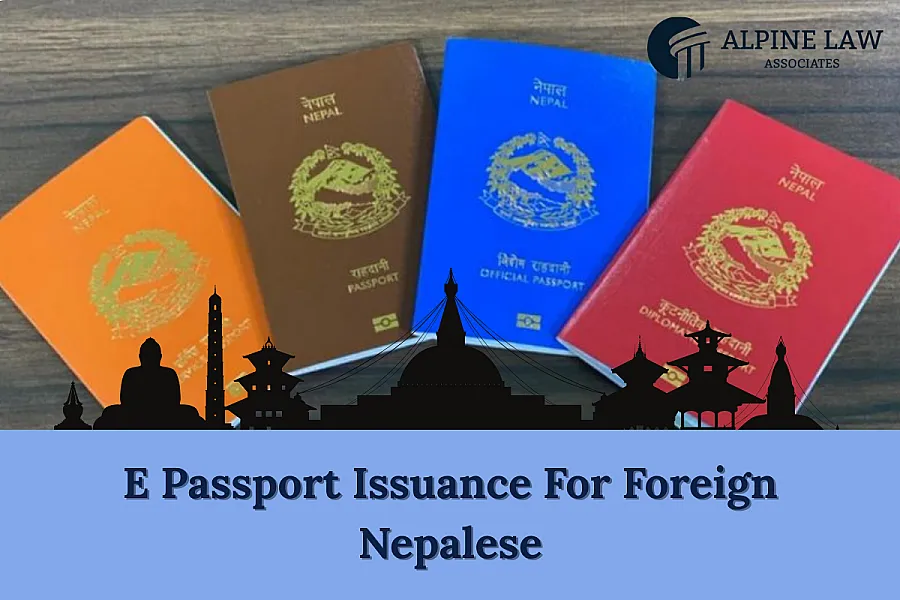
Nepal has been issuing the polycarbonate biometric-chip e-passport since 2021, replacing the prior machine-readable passport (MRP) format with an ICAO-compliant electronic travel document that carries the citizen's biometric data on an embedded chip. The transition is complete — every fresh issuance from the Department of Passports (DoP) under the Ministry of Foreign Affairs and from Nepali diplomatic missions abroad is now an e-passport. The framework rests on the Passport Act 2024 (1967) as updated through subsequent amendments, with the citizenship certificate as the foundational prerequisite and the National ID increasingly required at the application stage. For most travel purposes the e-passport is the operative document; understanding the process, the fee structure, and the timing variables is the practical difference between a stress-free renewal and a cancelled trip. See Alpine's immigration-law practice area for related matters.
This guide is the 2026 (2083 BS) practitioner's deep-dive on the Nepal e-passport — the statutory framework, the Department of Passports authority, eligibility, online pre-enrolment, document requirements, the full fee schedule (34-page and 66-page variants; adult, child, and lost-passport rates), processing timeline, the biometric capture step, the NRN embassy route abroad, child passports, renewal and lost / damaged procedures, and the practical compliance discipline. For the foundational citizenship document see our citizenship in Nepal pillar; for the National ID supplement see our NID registration guide.
Quick answer — E-passport in Nepal (2026):
The Nepal e-passport is the polycarbonate biometric-chip travel document issued by the Department of Passports (DoP) under the Ministry of Foreign Affairs. It is ICAO-compliant — meeting the International Civil Aviation Organization's specifications for machine-readable and biometric travel documents — and is universally accepted at international borders. The polycarbonate data page carries the citizen's photograph, demographic details, and machine-readable zone; an embedded electronic chip carries the citizen's biometric data (digital photograph, fingerprints, signature) plus the same demographic data in encrypted digital form, enabling secure machine reading at e-gates and immigration counters worldwide.
Nepal transitioned to the e-passport format in 2021, completing the rollout that replaced the prior machine-readable passport (MRP). Older MRP passports remain valid until their original expiry date — the holder need not pre-emptively renew unless approaching expiry — but every fresh issuance from the DoP and from Nepali diplomatic missions abroad is now exclusively the e-passport. The chip-based format provides materially stronger security against counterfeiting and identity theft, faster immigration processing where e-gates are deployed, and standardised cross-border verification.
The Department of Passports (DoP), an entity under the Ministry of Foreign Affairs (MoFA), is the issuing authority for all Nepal e-passports. The DoP operates the central facility in Kathmandu, the principal regional centres in major cities, and works through designated District Administration Offices for biometric capture and document submission in districts without dedicated passport facilities. For Nepali citizens abroad, the issuance authority shifts to the relevant Nepali Embassy or Consulate-General with consular jurisdiction over the applicant's location.
The DoP's public-facing online portal is at nepalpassport.gov.np. The portal hosts the pre-enrolment system, the fee schedule, the application-status tracking facility, the lost-passport reporting form, and the embassy contact directory. Embassy-based applications are coordinated through the respective mission's website with the same pre-enrolment principle (online form first, biometric capture at the mission's biometric facility, collection on the prescribed date).
Eligibility is straightforward: every Nepali citizen holding a valid citizenship certificate can apply. The citizenship certificate under the Citizenship Act 2063 is the foundational prerequisite — no e-passport can be issued without it. For applicants who have not yet obtained citizenship (typically because they have not yet reached the age-16 threshold, or because their citizenship application is in process), the e-passport process has separate pathways:
National ID is increasingly required at the application stage as the DoP integrates the passport database with the DoNIDCR National ID framework. Applicants who have not yet obtained the NID may still apply but should complete NID registration in parallel — the trend is toward NID becoming a hard prerequisite over the coming years.
Pre-enrolment is conducted online through nepalpassport.gov.np. The applicant creates an account using mobile number and verifies via OTP, then enters demographic data: full name (exactly matching the citizenship certificate), gender, date of birth, place of birth, parents' names and citizenship references, current and permanent addresses, marital status, spouse details where applicable, profession, contact details. The portal validates the citizenship reference against the DoNIDCR-citizenship database and flags any inconsistencies.
Once the demographic data is complete, the applicant selects the passport type (34-page or 66-page) and the urgency level (regular or fast-track where available), uploads scanned copies of the supporting documents (citizenship, photograph, NID where applicable), and books an appointment at the central DoP, the assigned DAO, or the relevant Nepali embassy. The system issues a unique application reference number and a printable receipt. The applicant pays the prescribed fee through the integrated payment gateway or at the prescribed bank counter, then carries the receipt and the original documents to the biometric appointment.
The biometric session takes place in person at the central DoP facility in Kathmandu, the assigned DAO for the applicant's district, or the Nepali embassy abroad for NRNs. The applicant attends on the appointment date with: the application receipt and reference number; the original citizenship certificate (and original NID where applicable); the original old passport for renewals; the police FIR for lost-passport cases; the child's birth certificate for child applications; the parent's citizenship for child applications; and any additional documents specified at booking.
The biometric officer verifies the originals against the digital application file, then captures the four biometric elements: fingerprints (10 fingers, rolled, on a digital fingerprint scanner); iris scan (both eyes, by infrared scanner); photograph (high-resolution face capture against neutral background, biometric-grade); electronic signature (signed on a digital pad). The applicant reviews the captured data, confirms accuracy, signs the consent receipt, and receives a collection date for the issued passport. The session typically takes 15-to-30 minutes for a clean application.
For a clean application processed through the central DoP or a designated DAO, the typical timeline is 7 to 15 working days from biometric capture to collection. The exact duration depends on the DoP's printing queue, the seasonal volumes (summer travel periods see longer queues), and any quality-control flags raised on the application. Fast-track service is available in some categories with a premium fee, reducing the timeline to 3-to-5 working days, though availability varies by season and capacity. Some categories — minor children, lost-passport replacements with court documentation, applications with mismatched demographic data requiring verification — typically take longer.
For Nepali embassies and consulates abroad, the timeline is meaningfully longer at 6 to 8 weeks. The biometric data is captured at the embassy but the actual passport printing happens centrally in Nepal — the data is transmitted, the passport is printed and personalised at the DoP, and the finished passport is shipped back to the embassy for delivery to the applicant. Major missions (Washington DC, London, Tokyo, Sydney, Doha, Riyadh) typically have stable timelines around the 6-to-8 week mark; smaller missions may take longer. NRNs anticipating international travel should apply well in advance — at least 3 months before any planned travel where possible.
The standard document set for an adult applicant:
For a child applicant: child's birth certificate (original); both parents' citizenship certificates; one parent's attendance at biometric session (the child also attends); recent passport-size photograph of the child; parents' consent and signature on the application form. For a lost-passport replacement: the police First Information Report (FIR) filed at the local police station detailing the loss circumstances; sworn affidavit from the applicant; the application form noting the lost-passport status; the higher fee schedule applies.
Nepali citizens abroad apply for e-passports through the relevant Nepali Embassy or Consulate-General with consular jurisdiction over their location. The major missions — Australia (Canberra), USA (Washington DC), UK (London), Japan (Tokyo), Korea, Qatar, Saudi Arabia, UAE, and others — operate biometric facilities and conduct the application sessions. The applicant pre-enrols through the mission's website (which links to or replicates the central nepalpassport.gov.np system), books the appointment, attends with original documents, and waits for the centrally-printed passport to be dispatched.
The fee schedule abroad is typically USD 150 for 34-page passport and USD 200 for 66-page passport, payable in the local currency at the prevailing exchange rate or in USD where the mission accepts it. Processing time is approximately 6 to 8 weeks from the biometric session — substantially longer than domestic processing because the biometric data is transmitted to Kathmandu, the passport is printed at the central facility, and the finished passport is shipped back to the issuing mission. NRNs anticipating international travel must plan accordingly; renewals should be initiated at least 3 months before existing passport expiry where possible.
Children below age 18 receive e-passports with 5-year validity (compared to 10-year for adults). The application is filed by a parent or legal guardian on behalf of the child, with the child also attending the biometric session (the child's fingerprints, photograph, and electronic signature are captured). For very young children (typically below 5 years), the biometric protocol is adapted — fingerprints may be skipped or simplified, with the photograph and signature being the primary biometric elements.
The required documents for a child passport: the child's birth certificate (original); both parents' citizenship certificates (original and photocopies); a written consent from both parents (with photographs); the child's recent biometric-quality photograph; the parents' marriage certificate; and the standard application receipt. Where one parent is deceased or unreachable, additional documentation is required — death certificate of deceased parent, court order in custody cases, sworn affidavit and supporting evidence in non-cooperation cases. The reduced fee schedule applies for child passports (NPR 9,500 for 34-page; NPR 14,500 for 66-page).
E-passport renewal follows the same application process as a new passport — online pre-enrolment, biometric capture, fee payment, collection. The renewing applicant brings the existing passport to the biometric session; the original is surrendered at the collection of the new passport (cancelled, with stamps and notation indicating supersession). The renewal can be initiated up to 6 months before the existing passport's expiry; renewals attempted earlier are typically deferred unless there is special cause (passport pages full, name change, lost original).
For renewals where the citizen's particulars have changed (name change through marriage, address change, profession change), supporting documentation establishing the change is presented alongside the standard application — marriage certificate for name change, ward letter for address update, etc. The new passport is issued with the updated particulars and a fresh 10-year (or 5-year for child) validity from the date of issuance. Renewals attempted after the existing passport has already expired follow the same procedure as a fresh issuance — the expired passport is presented as evidence of prior issuance but treated as effectively new for the renewal cycle.
A lost passport must be reported promptly to the local police station — a First Information Report (FIR) is filed detailing the circumstances of loss (theft, accidental loss, damage). The FIR is the foundational document for the lost-passport replacement application. The replacement application follows the standard online pre-enrolment process with the lost-passport status declared, the FIR uploaded, and the higher fee schedule applied (NPR 17,000 for 34-page; NPR 25,000 for 66-page — versus NPR 5,000 / NPR 10,000 for regular fresh issuance).
For passports lost abroad, the FIR is filed at the local police authority in the country where the loss occurred, with a copy and supporting documentation provided to the Nepali Embassy. The embassy may issue an emergency travel document for the applicant to return to Nepal where a full lost-passport replacement can be processed. For damaged passports (water damage, torn pages, illegible data), the damaged original is brought to the biometric appointment and presented — the higher fee schedule for damaged-passport replacement applies, but the FIR requirement does not (there is no theft or loss being reported, only physical damage). The new passport is issued under the standard timeline once the application is complete.
The three identity-document frameworks are designed to work together. The citizenship certificate under the Citizenship Act 2063 is the foundational status document — establishing Nepali citizenship. The National ID (NID) under the NID Act 2076 supplements it with a unique 10-digit identification number (NIN) and biometric record. The e-passport under the Passport Act 2024 framework is the international travel document, drawing on both the citizenship and the NID data. Without citizenship, no passport. Without NID (increasingly), no current-cycle passport. The integration trend through DoNIDCR's policy direction is single-source citizen identity with the NID as the universal anchor and the passport as the international-travel extension.
Where any of the underlying documents has issues — citizenship discrepancies, NID-database mismatches, ward-record gaps — the e-passport application is similarly affected. Resolving the underlying document issue is the prerequisite for the e-passport to issue cleanly. For complex cases (cross-district address moves, marital-status changes, family-record updates, mixed-citizenship situations), professional advice on the document chain typically saves the passport application from multiple iterations.
From practitioner experience, the recurring patterns are: name discrepancies between citizenship, NID, and the application — particularly common where the citizen has multiple Romanisations of the Devanagari name across documents; missing or expired NID where the applicant has not yet completed NID registration; citizenship-database flag where the DAO citizenship record has not been digitised or has data inconsistencies; address-history complications where the citizen has moved between districts but the records have not been harmonised; photograph format issues where the digital biometric capture has quality issues requiring re-capture; insufficient fee payment where the applicant misjudged the passport-type or category and paid the wrong amount.
For child passports, the recurring patterns are: missing or contested parental consent particularly in post-divorce custody cases; birth certificate gaps for older children who were never registered or whose birth records have been lost; biometric capture difficulties for very young children whose fingerprints are not yet fully developed. For NRN cases abroad: appointment scarcity at major missions during peak travel seasons; citizenship-status questions where the applicant has lived abroad for extended periods; lost-passport-abroad emergencies requiring emergency travel documents in coordination with the embassy.
Alpine Law Associates supports e-passport applications across the lifecycle for citizens, families, NRNs, and businesses with employee-mobility needs. Application support — pre-enrolment review, document set assembly, biometric appointment coordination, fee structure advisory. Complex cases — name-discrepancy resolution across citizenship, NID, and prior documents; address-history harmonisation; post-divorce or post-marriage name-change applications. Child passports — parental consent coordination including post-divorce custody cases; birth-certificate gap resolution; biometric capture preparation for very young children. NRN abroad — embassy coordination, fee planning, advance scheduling for travel-sensitive renewals, emergency travel document support. Lost / damaged replacement — police FIR coordination, sworn affidavit preparation, replacement-fee schedule advisory. Renewal — timing optimisation, updated-particulars documentation, expired-passport-cycle restoration. Speak with our lawyers today →
The Nepal e-passport is the polycarbonate biometric-chip travel document issued by the Department of Passports (DoP) under the Ministry of Foreign Affairs. It is ICAO-compliant and contains an embedded electronic chip storing the citizen's biometric data (photograph, fingerprints, signature) and demographic data in encrypted form. Nepal transitioned to the e-passport format in 2021, completely replacing the prior machine-readable passport (MRP). Older MRP passports remain valid until expiry, but every fresh issuance is now an e-passport.
The Department of Passports (DoP) under the Ministry of Foreign Affairs is the issuing authority. The DoP operates the central facility in Kathmandu, the principal regional centres, and works through designated District Administration Offices for biometric capture and document submission. For Nepali citizens abroad, the relevant Nepali Embassy or Consulate-General with consular jurisdiction over the applicant's location handles the application. The public portal is at nepalpassport.gov.np.
Every Nepali citizen holding a valid citizenship certificate is eligible. The citizenship certificate is the foundational prerequisite. For children below the citizenship-age threshold, the application uses the child's birth certificate plus parental citizenship. Naturalised citizens are eligible once the naturalisation certificate is issued by the Ministry of Home Affairs. NRNs retaining Nepali citizenship apply through the relevant embassy abroad. National ID is increasingly required as an additional document.
Adult e-passports (age 18 and above) are issued with 10-year validity from the date of issuance. Children below age 18 receive e-passports with 5-year validity. At expiry, the holder renews through the standard application process. Renewal can be initiated up to 6 months before the existing passport's expiry — earlier renewals are typically deferred unless there is special cause (passport pages full, name change, lost original).
The Department of Passports operates a two-tier domestic schedule. Regular processing: NPR 5,000 (34-page) and NPR 10,000 (66-page). Fast-track processing: NPR 12,000 (34-page) and NPR 20,000 (66-page). Child fees (under 10 years): NPR 9,500 for 34-page, NPR 14,500 for 66-page. Lost or damaged passport replacement: NPR 17,000 for 34-page, NPR 25,000 for 66-page. Embassy abroad: regional tiers — USD 150/200 in USA, Australia, Japan, Korea, Hong Kong; USD 80/130 in other Asia / Africa; USD 50/100 in Middle East and selective Asian; EUR 80-to-170 in European missions.
For a clean application at the central DoP or designated DAO, the typical timeline is 7 to 15 working days from biometric capture to collection. Fast-track service is available in some categories with a premium fee, reducing the timeline to 3 to 5 working days. Embassy applications abroad take 6 to 8 weeks because biometric data is transmitted to Kathmandu, the passport is printed centrally, and the finished passport is shipped back to the embassy. NRNs should apply at least 3 months before any planned travel.
Online pre-enrolment runs through nepalpassport.gov.np. The applicant creates an account with mobile number and OTP verification, enters demographic data matching the citizenship certificate, selects the passport type (34-page or 66-page), uploads scanned documents (citizenship, photograph, NID), books an appointment at the central DoP, designated DAO, or embassy, pays the prescribed fee, and prints the receipt. The receipt and originals are carried to the in-person biometric appointment.
Adult applicants need: citizenship certificate (original and photocopy); recent biometric-quality passport-size photographs; National ID (where issued); application receipt from online pre-enrolment; old passport for renewal cases; marriage certificate where applicable; bank fee receipt. Children need: birth certificate; both parents' citizenship; written parental consent; biometric-quality photograph; parents' marriage certificate. Lost-passport replacement requires: police FIR; sworn affidavit; lost-passport application form with the higher fee schedule.
Four biometric elements are captured at the in-person session: 10 fingerprints (rolled, on a digital fingerprint scanner); iris scan (both eyes, by infrared scanner); high-resolution biometric-grade photograph (face capture against neutral background); electronic signature (signed on a digital pad). The data is encrypted and programmed onto the e-passport's embedded chip, enabling secure machine reading at international e-gates and immigration counters. For very young children, the biometric protocol is adapted with simplified fingerprint capture.
Yes. Nepali citizens abroad apply through the relevant Nepali Embassy or Consulate-General with consular jurisdiction over their location. Major missions — Australia, USA, UK, Japan, Korea, Qatar, Saudi Arabia, UAE — operate biometric facilities. The applicant pre-enrols through the mission's website, books an appointment, attends with original documents, and the centrally-printed passport is dispatched from Kathmandu. Fees are typically USD 150 for 34-page and USD 200 for 66-page; processing takes 6 to 8 weeks.
Child passport applications (children under 18) are filed by a parent or legal guardian. The child also attends the biometric session — fingerprints, photograph, electronic signature are captured (biometric protocol simplified for very young children). Documents: child's birth certificate; both parents' citizenship; written parental consent with photographs; child's biometric-quality photograph; parents' marriage certificate. Fee: NPR 9,500 for 34-page, NPR 14,500 for 66-page. Validity is 5 years. At age 18 the child renews under the adult framework.
Renewal follows the same process as a new application — online pre-enrolment, biometric capture, fee payment, collection. The existing passport is brought to the biometric session and surrendered at collection of the new passport (cancelled with stamps and notation). Renewal can be initiated up to 6 months before the existing passport's expiry. The new passport is issued with a fresh 10-year (or 5-year for child) validity. Renewals where the citizen's particulars have changed (name through marriage, address, profession) include supporting documentation establishing the change.
Report the loss to the local police station and obtain a First Information Report (FIR) detailing the circumstances. The FIR is the foundational document for the lost-passport replacement application. Apply through nepalpassport.gov.np with the lost-passport status declared, upload the FIR, and pay the higher fee schedule (NPR 17,000 for 34-page, NPR 25,000 for 66-page versus NPR 5,000 / NPR 10,000 for regular fresh issuance). The replacement passport is issued under the standard timeline once the application is complete.
File the FIR at the local police authority in the country where the loss occurred, with a copy and supporting documentation provided to the Nepali Embassy. The embassy can typically issue an emergency travel document for the applicant to return to Nepal where a full lost-passport replacement can be processed. The full replacement is filed through the standard nepalpassport.gov.np route once back in Nepal. For NRNs unable to return to Nepal, the embassy may process the replacement directly under the longer 6-to-8 week timeline.
For damaged passports (water damage, torn pages, illegible data), the damaged original is brought to the biometric appointment for surrender. The replacement application uses the higher damaged-passport fee schedule (NPR 17,000 for 34-page, NPR 25,000 for 66-page) but does not require a police FIR (no loss or theft is being reported, only physical damage). The new passport is issued under the standard timeline. For passports damaged abroad, the same principles apply through the relevant embassy.
The 34-page passport is the standard issuance suitable for most citizens — adequate for a normal pattern of international travel over 10 years. The 66-page passport doubles the visa-page capacity and suits frequent international travelers, business travelers, and those whose visa stamps accumulate quickly. The fee is higher (NPR 10,000 vs NPR 5,000 regular, or NPR 20,000 vs NPR 12,000 fast-track). The choice is entirely the applicant's based on expected travel frequency. The biometric chip and other security features are identical between the two formats.
The National ID is increasingly required as the Department of Passports integrates the passport database with the DoNIDCR National ID framework. Applicants who have not yet obtained the NID may still apply but should complete NID registration in parallel — the trend is toward NID becoming a hard prerequisite over the coming years. Where the application proceeds without NID, the citizenship certificate is the principal identification; some applications may attract additional verification time without the NID linkage.
No. Section 10 of the Citizenship Act 2063 provides that voluntary acquisition of foreign citizenship triggers automatic loss of Nepali citizenship by operation of law. Once Nepali citizenship is lost, the applicant is no longer eligible for the Nepali e-passport — the foreign passport applies. The NRN identity card under the NRN Act 2064 is the alternative structured-connection framework for former Nepali citizens. Re-acquisition of Nepali citizenship is possible through the naturalisation route (Article 13), but is discretionary and time-consuming.
At the collection of the new passport, the old passport is surrendered to the Department of Passports — typically returned to the applicant with cancellation stamps and notation indicating supersession. The cancelled old passport should be retained safely as it may be referenced for travel-history verification, visa applications to certain countries that require evidence of prior travel, and immigration-clearance for some destinations. The cancellation does not destroy the historical record; the old passport remains a valid identity-history document even after replacement.
Fast-track service is available in some categories with a premium fee, reducing the timeline from the regular 7-to-15 working days to 3-to-5 working days. Availability varies by season and DoP capacity; peak travel seasons (May-July, October-November) often see fast-track unavailable due to high regular demand. For genuinely emergency situations (medical evacuation, critical family events abroad), exception-clearance through the central DoP is sometimes possible — typically requiring documentary evidence of the emergency and individual case-officer discretion.
Name change on the passport (typically through marriage where a spouse adopts a new family name) is handled at renewal — the new application uses the updated name, with the marriage certificate and updated citizenship (or marriage certificate alone where the citizenship is being updated in parallel) as supporting documentation. For name corrections (typos, transliteration variants), the correction is also handled at the next renewal cycle or, in some cases, through a separate correction application during the validity of the existing passport. The cancelled old passport is returned with the original name.
The nepalpassport.gov.np portal provides a status-tracking facility. Entering the unique application reference number (provided at pre-enrolment) returns the current processing status — pre-enrolment received, biometric captured, in central printing, dispatched to issuing centre, ready for collection. The status updates progressively through the back-end stages. For embassy applications, status tracking is typically through the mission's website with the embassy-specific reference. Some applications attract SMS notifications for key status changes.
Generally the applicant collects the passport in person — particularly because biometric verification at collection confirms the identity of the recipient. For exceptional circumstances (medical incapacity, urgent absence), a representative can collect on behalf of the applicant with: written authorisation (typically notarised) from the applicant; the representative's identification (citizenship); the application receipt; and any additional verification the DoP requires. The representative's ability to collect is at the DoP's discretion and is not guaranteed in every case.
For errors discovered at collection (name spelling, date of birth, photograph misalignment), the passport is not collected — it is referred back to the DoP for correction. The error is investigated, the responsible party identified (applicant data-entry error vs DoP printing error), and the passport is reprinted with the correction. If the error was the applicant's data-entry error, the correction fee may apply; if it was the DoP's printing error, the correction is at no additional cost. For errors discovered after collection but before use, the same correction route applies through a new application.
Alpine Law Associates supports e-passport applications across the lifecycle — application support (pre-enrolment review, document assembly, biometric coordination, fee advisory); complex cases (name discrepancies, address harmonisation, post-marriage updates); child passports (parental consent, post-divorce custody, birth-certificate gaps); NRN abroad (embassy coordination, advance scheduling, emergency travel documents); lost or damaged replacement (FIR coordination, sworn affidavit, replacement-fee advisory); renewal (timing optimisation, updated-particulars documentation, expired-cycle restoration). Speak with our lawyers today →
Disclaimer:
This article is intended solely for informational purposes and should not be interpreted as legal advice, advertisement, solicitation, or personal communication from the firm or its members. Neither the firm nor its members assume any responsibility for actions taken based on the information contained herein.