Arms and Ammunition Act in Nepal 2026 — Licence Guide
"The Arms and Ammunition Act 2019 (1962, Act No. 45), as amended 10 times with the 10th Amendment to the Regul...
Read more →
Alpine Law Associates is the leading full-service law firm encompassing a wide range of legal practices located in Kathmandu, Nepal. It consists of a team of the country's best lawyers, each with expertise in their respective fields, tailored to meet clients' specific needs.
Anamnagar-29, Kathmandu


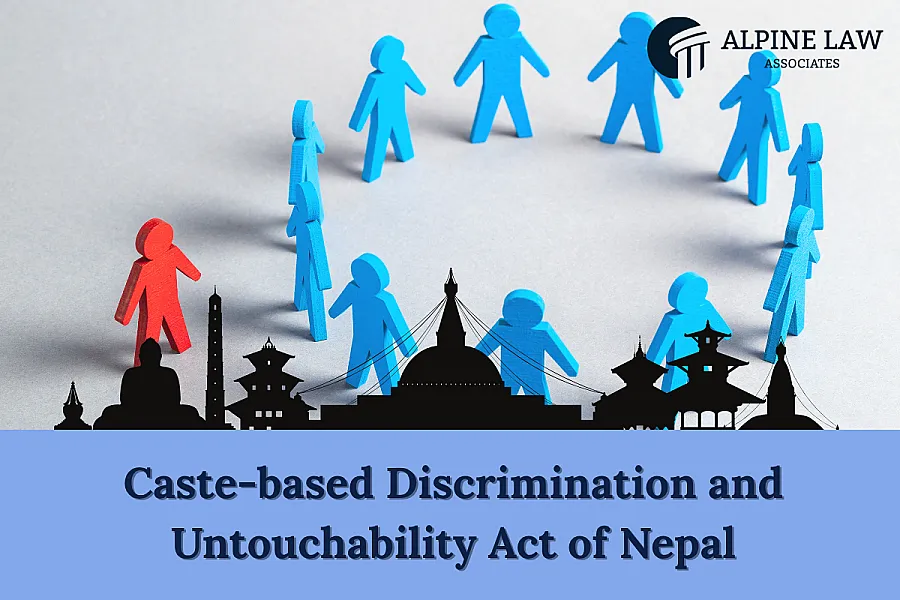
Nepal’s Caste-Based Discrimination and Untouchability (Offence and Punishment) Act 2068, amended in 2075, criminalises caste discrimination and untouchability. Article 24 of the Constitution protects the same right, while Section 7 sets imprisonment and fines and Section 8 provides compensation.
Nepal’s caste discrimination law creates criminal protection against exclusion, restriction, humiliation and unequal treatment based on caste, race, descent, community or class. Article 24 adds constitutional protection. The National Dalit Commission and National Human Rights Commission may provide complaint or rights-based routes, but the criminal case follows the legally recognised investigation and court process.
The Act prohibits caste-based discrimination, exclusion, restriction, humiliation and unequal treatment connected with caste, race, descent, community or class. Section 4 covers conduct in religious, educational, employment, service, public-place and private settings. The precise legal character of conduct depends on the facts and the applicable provision.
Examples described in the existing legal material include denying entry to public places, religious sites or water sources; obstructing an inter-caste marriage; denying education or employment opportunities; refusing services in restaurants, hotels or transport; publicly abusing a person through caste-based words; and forcing a person to follow a discriminatory custom.
The protection is therefore wider than a single incident at a temple or water source. A private act may still raise an issue under the Act. An employer, service provider, institution or individual may need separate legal analysis because the evidence and statutory application can differ.
For constitutional context, you can read our guide to Nepal legal rights and related laws. The official Act text is available through the Nepal Law Commission.
Dalit rights in Nepal rest on both the Constitution and the Caste-Based Discrimination and Untouchability Act 2068. Article 24 protects people from untouchability and caste discrimination, while the Act defines offences and punishment. The National Dalit Commission is a relevant constitutional institution, but it is not the criminal trial court.
Article 24 is the main constitutional anchor for the search phrase constitution article 24. Its clauses address caste discrimination generally, discrimination in places of public use, caste-based discrimination in producing or distributing goods and services, and discrimination in the workplace.
Article 24 also states that any act of untouchability is a severe social offence punishable by law. It recognises a victim’s right to compensation. That constitutional protection does not remove the need to establish the facts of a particular complaint under the relevant law.
The Constitution is not merely a statement of social policy. It provides a rights framework that can guide complaints and legal arguments. The official English Constitution text can be checked through the Office of the Attorney General source.
Section 7 provides the principal punishment for an offence under the Act: three months to three years’ imprisonment and a fine of NPR 50,000 to NPR 200,000. The First Amendment 2075 raised the earlier punishment schedule. A public servant abusing official position may receive a 50% enhancement to the base punishment.
The punishment is described as imprisonment plus a fine. These are statutory amounts, not professional fees or government application charges. The court applies the law to the proved offence and the circumstances before it. The final result cannot be promised from the allegation alone.
The material also states that aiding or abetting attracts half of the principal punishment. That means the legal position of a person accused of assisting may differ from the position of the principal offender. The facts, role and applicable provision require careful review.
| Issue | Legal position stated in the supplied material | Practical caution |
|---|---|---|
| Principal offence | Section 7: three months to three years’ imprisonment and NPR 50,000 to NPR 200,000 fine | The court determines liability and punishment on the proved facts. |
| Public servant | 50% enhancement where official position is abused | The public-service condition must be established. |
| Aiding or abetting | Half of the principal punishment | The person’s actual role matters. |
| Victim compensation | Section 8: NPR 25,000 to NPR 100,000, plus medical and additional expenses | Keep evidence of expenses and loss connected with the offence. |
Section 8 gives the District Court power to order NPR 25,000 to NPR 100,000 compensation to the victim, together with medical expenses and additional expenses arising from the offence. Compensation is separate from the criminal punishment and is connected to the court’s decision on the established case.
The supplied material describes compensation as payable by the convicted offender. It also states that the compensation order forms part of the District Court judgment and may be enforceable as a civil decree if payment is not made voluntarily.
Preserve material showing the harm and expenses connected with the allegation. The available source material does not provide a universal document checklist, so you should verify filing and proof requirements with the receiving authority or obtain case-specific legal advice.
Article 24 also recognises a compensation right. A constitutional right and a statutory compensation order should not be confused with an automatic payment before the facts are decided.
A person affected by alleged caste discrimination may approach the Nepal Police for an FIR, meaning the formal first information report used to begin a criminal investigation. The National Dalit Commission, local level and National Human Rights Commission may also be relevant. The correct route depends on the conduct and the authority’s response.
The current material identifies Nepal Police as the first complaint route. It also states that an escalation may be made to the National Dalit Commission within 15 days if police refuse to register the FIR. It separately identifies the local ward or municipality and the National Human Rights Commission as possible routes.
Do not assume that every body performs the same function. A police complaint concerns criminal investigation. The National Dalit Commission concerns Dalit-rights complaints and institutional action. The NHRC route concerns a human-rights dimension. The District Court hears the criminal trial.
If the police response is unclear, keep a record of the complaint, the date, the office approached and the response received. Verify the current receiving office and procedure before relying on the 15-day escalation route.
The National Dalit Commission is a constitutional body connected with Dalit-rights protection. The supplied material describes it as receiving complaints, investigating discrimination matters, forwarding complaints where an FIR has been refused, monitoring implementation and publishing statistics. It is not the criminal trial court; the District Court remains the stated trial forum.
The Commission may therefore be relevant when a person faces difficulty obtaining police registration or wants the rights dimension recorded. Its involvement does not automatically prove the offence or guarantee prosecution. The facts still need assessment under the Act and the criminal process.
For a victim, the useful question is not only “Which office should I visit?” It is also “What happened, when did it happen, who was involved, and what response did each authority give?” A clear chronology helps distinguish a criminal complaint from an administrative or rights complaint.
The Commission’s role should also be separated from informal settlement. The current material states that local-level involvement may be a parallel route and that mediation may occur in some settings. Mediation should not be treated as a substitute for legal advice where serious criminal conduct is alleged.
The complaint process begins with recording the incident and identifying the appropriate authority. The supplied material identifies the Nepal Police FIR route, escalation to the National Dalit Commission after refusal, possible local-level or NHRC complaints, and District Court trial. Receiving offices may require verification of current procedure and supporting material.
This is a process framework, not a guarantee that an authority will register, investigate or prosecute a complaint. If you are outside Nepal, or if the incident affects a person living abroad, the practical route may require a representative and should be verified with the relevant office.
The supplied sources do not establish one universal document list for every caste discrimination complaint. Evidence may include the victim’s account, witness information, messages, photographs, recordings, medical material and records of expenses. The receiving authority can require verification of identity, incident details or other material, so confirm current requirements before filing.
Evidence should show more than that an unpleasant event occurred. It should help explain the caste-based reason, exclusion, restriction, humiliation or unequal treatment alleged. For example, a service refusal may require evidence of the words used, the setting, the people present and the reason given.
Do not edit or circulate sensitive material carelessly. Preserve original files where possible and keep a simple chronology. If a recording or online post is involved, ask for advice before reposting it. The legal significance of online caste-based content depends on the content and the circumstances.
A complaint can be legally serious even where evidence is incomplete. It is better to present what you have accurately than to add assumptions. Never create a witness, alter a record or exaggerate an injury.
The supplied material establishes one specific period: escalation to the National Dalit Commission within 15 days after refusal to register an FIR. It does not establish a universal police, Commission or District Court processing time. The actual timeline can depend on the authority, evidence, investigation and court schedule.
Do not rely on a promised completion date. A complaint may involve separate stages: police registration, investigation, prosecutorial action, District Court proceedings and possible appeal. Each stage can raise different questions. The current material identifies appeal to the High Court and Supreme Court but gives no fixed duration.
If an office gives you a date or asks you to return with material, keep that information in writing. If you are concerned about the 15-day period, seek advice quickly. Missing a stated period may affect the available escalation route, and the receiving authority should verify the current procedure.
Common risks include delaying action, failing to record a police refusal, treating mediation as the only remedy, losing original evidence and describing discrimination without explaining the caste-based connection. Another risk is relying on old penalty figures. The post-2018 Section 7 figures in this guide are the verified statutory amounts supplied for this article.
Do not assume that every offensive statement automatically proves an offence under this Act. The wording, setting, audience, conduct and evidence matter. Equally, do not dismiss a complaint because the conduct occurred in a private setting; the Act’s stated scope includes private contexts.
Do not promise a result because a complaint has reached the National Dalit Commission or NHRC. These bodies may assist with complaint or rights processes, but the criminal court decides the criminal case on the evidence and applicable law.
Finally, do not publish a victim’s identity or sensitive evidence without considering safety and legal consequences. A lawyer can help you decide what should be submitted, what should remain private and which authority should receive it.
The existing material identifies the West Rukum, or Soti, incident of May 2020 as a major caste-discrimination and inter-caste-marriage case. It also identifies a Ramechhap case in 2022 involving a 13-year-old Dalit girl and reports a punishment of three-and-a-half years’ imprisonment plus NPR 35,000 fine. These examples do not decide another case’s outcome.
The supplied material also identifies Bimal Bishwokarma v. Office of the Prime Minister and Council of Ministers as a Supreme Court judgment relevant to enforcement of Dalit rights. The judgment should be read for its actual reasoning rather than reduced to a slogan.
These cases show why the facts need careful separation. Inter-caste marriage, violence, public humiliation, unlawful confinement and discrimination may involve more than one legal issue. The Caste Discrimination Act may be relevant alongside other criminal or constitutional questions.
You can review the supplied Supreme Court judgment through the Supreme Court source.
Suppose a person is refused a service after being identified by caste, and witnesses hear an accompanying caste-based insult. The person records the date, place, words used, witnesses and any immediate loss, then approaches Nepal Police. If the FIR is refused, the person records that refusal and verifies the stated 15-day National Dalit Commission escalation route.
This is an illustrative scenario, not a prediction of registration, investigation or compensation. The authority would still assess the conduct, evidence and applicable law. If the incident also involved threats, physical harm or online publication, additional legal issues might require separate analysis.
The scenario also shows why the complaint should be specific. “I was treated badly” may not explain the legal basis. A clear account should identify the caste-based conduct, the place, the people involved, the response and the evidence available.
A criminal complaint is not the only possible route. The supplied material identifies the National Dalit Commission, local ward or municipality and National Human Rights Commission as possible parallel or escalation routes. The suitable option depends on whether you need investigation, rights protection, local intervention or court representation.
Local-level action may involve mediation, but mediation is not automatically appropriate for serious or coercive conduct. It should not be treated as a waiver of rights without understanding the consequences. A rights complaint also does not itself replace the criminal investigation or District Court process.
If the matter involves employment, education, a public service, an inter-caste marriage or online material, explain the full context. Separate laws or remedies may apply. A person outside Nepal should verify whether a representative can act and what the receiving authority accepts.
For related criminal representation, see Alpine’s criminal law practice in Nepal. Our team can help assess the facts, prepare a legally focused account and advise on representation, but cannot promise registration, prosecution, compensation or a particular result.
Start by protecting your safety, preserving evidence and writing a truthful chronology. Then verify the receiving authority, the current filing method and any stated deadline. The 15-day period in this material relates to escalation after FIR refusal, not to every caste discrimination complaint or every legal remedy.
Bring the issue to a lawyer promptly if there is violence, a threat, pressure to withdraw, a child victim, an inter-caste marriage issue or a risk that evidence will disappear. Do not sign a statement you do not understand. Ask for an explanation of any proposed settlement or withdrawal.
Legal advice must remain fact-specific. This article explains the supplied statutory framework and complaint routes; it is not a substitute for advice on your evidence, safety, limitation or forum.
In short: Nepal’s untouchability law protects against caste-based exclusion and discrimination through Article 24 and the Caste-Based Discrimination and Untouchability Act 2068. Section 7 provides the stated criminal punishment, Section 8 provides compensation, and the National Dalit Commission may be relevant after FIR refusal. Verify current procedure with the office.
Readers researching Dalit rights and related protection in Nepal may also find these topics useful:
If you need advice about a caste discrimination complaint, FIR refusal, National Dalit Commission escalation or court representation, contact Alpine Law Associates. Our team can also discuss criminal case litigation services in Nepal based on your facts and the current requirements of the receiving authority.
Disclaimer:
This article is intended solely for informational purposes and should not be interpreted as legal advice, advertisement, solicitation, or personal communication from the firm or its members. Neither the firm nor its members assume any responsibility for actions taken based on the information contained herein.
-thumb.webp)
-thumb.webp)