
Debt Recovery Tribunal Nepal (2026): BFI Loan Recovery
A 2026 practitioner's guide to the Debt Recovery Tribunal (DRT) in Nepal — establishing law under the Debt Rec...
Read more →
Alpine Law Associates is the leading full-service law firm encompassing a wide range of legal practices located in Kathmandu, Nepal. It consists of a team of the country's best lawyers, each with expertise in their respective fields, tailored to meet clients' specific needs.
Anamnagar-29, Kathmandu


Court file recovery in Nepal is handled through reconstitution under the National Civil Procedure Code 2074, the Supreme Court Act 2073 framework, Court Administration Regulations and Supreme Court Rules. No single fixed timeline is established in the supplied material, so you should verify the position with the receiving court. Our civil law team can help assess the record.
Court file recovery in Nepal rebuilds an unavailable court record so the matter may continue, but the court controls the official reconstitution. A party may apply, or the court may act after noticing the loss. Copies from parties, advocates, the registry and appellate records can assist, while the exact timeline, filing format and charges must be verified with the court.
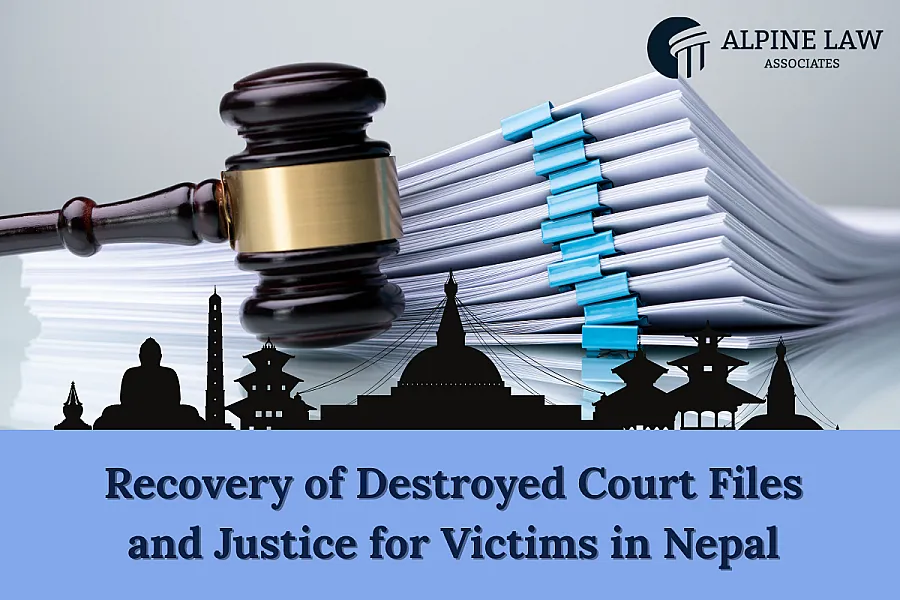
Court file recovery means rebuilding a court record that is lost, destroyed, damaged or otherwise unavailable. The court manages the process under the National Civil Procedure Code 2074 and related court-administration rules. The reconstructed record may support continuation of the existing case, but the receiving court decides what material is accepted as part of its official file.
A court file is the working record of a proceeding. Depending on what survived, it may include pleadings, written statements, evidence material, orders, procedural directions, judgment-related papers and execution records. The supplied material also identifies registry duplicates, certified-copy issuances, advocate records and appellate records as possible reconstruction sources.
“Reconstitution” is the formal word for rebuilding the record. It is not the same as starting a fresh case. It is also not, by itself, an appeal, review or retrial. Those distinctions matter because a party seeking a lost court file should explain the record problem clearly rather than asking for a new decision on the original dispute.
A lost court file may require reconstitution whenever the court cannot produce the record needed for the proceeding. The supplied material identifies loss, destruction, damage and misplacement as relevant situations, including records affected by fire, flood, storage problems, mishandling or other events. The exact cause should be reported accurately and verified with the registry.
File loss can create different practical problems. A scheduled hearing may be affected because the judge or registry cannot locate the record. A party may be unable to obtain a copy of an earlier order. An appeal or execution-related step may be delayed because the lower-court record is incomplete. These consequences vary with the stage of the matter and the material that remains available.
The current article also identifies the 2015 Gorkha earthquake as a disaster context in which court records in affected districts suffered damage. That history shows why physical records may need reconstruction after a large event. It does not establish a special present-day procedure or a guaranteed priority for any individual file.
The National Civil Procedure Code 2074 provides the principal civil-procedure framework identified in the supplied sources, while the Supreme Court Act 2073, Court Administration Regulations and Supreme Court Rules address court administration and record management. The applicable rule may depend on the court and case type, so verify the current text and practice with the relevant registry.
The Nepal Law Commission’s materials are identified as supporting the Code provisions on records and reconstitution. The Supreme Court website is identified as supporting Supreme Court rules on case-record management and reconstitution. The Ministry of Law and Justice is identified as the oversight body for court administration. You can review the Nepal Law Commission materials and the Supreme Court website, but online material should not replace confirmation from the court handling your case.
The supplied material does not provide a verified section number for the reconstitution rule. For that reason, this article does not attach a section number from memory or from an unverified summary. If a lawyer or registry gives you a section reference, check that it matches the current statute, rule or regulation before relying on it.
A party may raise the missing record with the court that held it, and the court may also initiate reconstitution after noticing the loss. The supplied material does not establish one exclusive applicant, a universal application form or a single filing counter for every court. Ask the registry to confirm the receiving office, required format and supporting papers.
A party should act promptly after learning that the file cannot be produced. First record what happened: the case number if known, the parties, the court, the last known procedural stage and the date on which the absence was discovered. Do not describe a file as destroyed if the registry has only said it is untraceable. The distinction may matter to the court’s inquiry.
If you have a lawyer, ask the advocate to preserve the complete litigation file before papers are misplaced. Keep pleadings, court-issued orders, certified copies, evidence lists, hearing notes and correspondence together. A lawyer can help identify gaps, but the court—not the lawyer—decides whether a copy enters the official reconstructed record.
The recovery process normally moves from reporting the absence to collecting copies, notifying parties, checking sources and recording the court’s decision. The supplied material supports this general sequence, but it does not establish one fixed deadline, hearing date or processing period. Verify each procedural step with the court registry before filing or attending.
This sequence is a practical explanation, not a promise that every case will follow identical steps. The court can ask for clarification or additional material. A party should comply with a specific direction rather than relying only on a general checklist.
Copies held by parties, advocates, registries and appellate courts can assist reconstitution. The supplied material identifies pleadings, written statements, evidence lists, orders, certified-copy issuances, registry duplicates and surviving fragments. It does not establish a universal document checklist. The court may require different material depending on the missing portion and the case stage.
| Possible source | What it may help show | What you should verify |
|---|---|---|
| Party’s copy | Pleadings, written statements, applications or evidence material | Whether it is signed, stamped, served or only a draft |
| Advocate’s file | Copies of filings, orders, hearing papers and case correspondence | Which papers were actually filed or issued by the court |
| Registry record | Case entries, filing history and available duplicate information | Whether the entry covers the missing document or only the event |
| Certified copy | An official duplicate of an order, judgment or other issued record | Its scope, date and connection to the lost file |
| Appellate record | Material transmitted or used in an appeal | Whether the appeal file contains the particular lower-court page needed |
Do not treat an unsigned draft as equivalent to a court-issued copy. Do not assume that one surviving page proves the contents of every missing page. Where versions differ, submit both versions with an explanation. The court may decide which material is reliable after comparing dates, stamps, registry entries and other available sources.
The court decides the contents and status of the reconstructed record after considering the available copies and court-held information. A consistent copy may assist, but the supplied material does not create an automatic priority rule for every document. The registry may seek explanations where papers conflict, are incomplete or cannot be linked to the case.
Authentication is a practical concern. A copy that identifies the case, court, parties and procedural stage is easier to assess than an isolated page. Certified copies and documents bearing court stamps may help show that a paper was issued or filed. Still, the court must determine whether the item belongs in the official record.
Parties should keep a schedule of every paper supplied. Note the document name, date, source and whether it is an original, copy, certified copy or draft. This record helps prevent accidental omissions. It also makes it easier to answer a registry question without changing the substance of the evidence.
No fixed recovery timeline is established in the supplied material. The duration may depend on the court, the condition of the record, the number of parties, the quantity of missing material, available registry entries and any dispute about competing copies. Ask the receiving court for the current position instead of relying on an advertised period.
A file with clear copies and a complete registry trail may present different issues from a file missing pleadings, evidence and orders. A multi-party case may also require more notice and checking. An appeal or execution matter can add another record source. These are factors to raise with counsel and the registry, not guaranteed timelines.
During recovery, protect any limitation or hearing position that may affect your case. The current article mentions limitation considerations during the recovery window, but the supplied material does not establish a universal suspension or extension rule. Do not assume that a missing file automatically stops every deadline. Seek a specific direction or legal assessment for your case.
The total cost is not fixed by the supplied material. Possible cost categories may include court charges, copying or certification charges where applicable, document preparation and professional fees. The current article does not provide a verified amount, and this guide does not state one. Confirm current charges with the court and obtain professional-fee information from counsel.
Cost can be affected by the size of the missing record, the number of parties, the need to obtain certified copies, the number of hearings and whether an appeal record must be checked. A simple inquiry is not necessarily the same as a contested reconstruction application. Ask what work is included before authorising legal assistance.
Our civil litigation service can help review the available papers and prepare a case-specific plan. We cannot promise a particular charge, processing time or restoration outcome because those matters depend on the court and the record.
Incomplete disclosure, unsupported assumptions and failure to preserve copies can make recovery harder. The court needs a reliable account of what is missing and what survives. A party should not overstate the loss, submit drafts as final documents or ignore a notice. Confirm the registry’s instructions and keep proof of every submission.
A clear chronology helps. State when the case began, what major documents were filed, which orders you hold, when the file was last seen and what the registry has said. Keep the account factual. The application should assist reconstruction, not turn the record-loss issue into a new dispute unless the court requires that issue to be examined.
An illustrative Nepal scenario shows why several sources may be needed. Suppose a civil case file cannot be produced before a scheduled proceeding, but one party holds a stamped pleading and an earlier order. The advocate has a further copy, and the registry has entries. The court may compare those materials before deciding the reconstructed record.
This example is illustrative only. It does not establish a filing requirement, outcome, deadline or document list. The parties would need to verify the actual process with the court. If the copies conflict, the court may ask for explanations or additional sources rather than accepting the first document submitted.
The result may also differ if the case has reached an appellate court. An appellate record might contain copies of lower-court material, but its existence does not prove that every page is available. The originating court and appellate court may need to coordinate, subject to their respective record-management directions.
Alternatives depend on what remains available and what relief the proceeding needs. A party may seek a certified copy of a surviving order, ask the registry to identify available entries, or provide appellate material for comparison. These are not substitutes for a court-approved reconstituted record when the court requires the complete file.
Important edge cases include a partially damaged file, a file lost during movement between courts, a record needed for execution, and a matter with an appeal already pending. A criminal, writ or appellate proceeding may carry different practical urgency, but the supplied material does not provide separate detailed rules for each category. Verify the applicable route.
If evidence is missing, do not assume it can simply be filed again. Ask whether the court wants a copy, a certified duplicate, an explanation of loss or another form of proof. Similarly, a judgment copy may help establish the decision, but it may not replace every pleading or evidence record needed for a later step.
The party reports and supplies material, the advocate helps organise it, and the court controls verification. The registry may identify surviving entries and copies, while other parties may contribute papers after notice. This division keeps the reconstructed file tied to official court authority rather than to one party’s private collection.
Start by preserving evidence of the case and confirming the record status with the registry. Write down the case details, gather every reliable copy, and ask what the court requires for reconstitution. Do not assume the file is permanently destroyed or that every deadline stops. Take case-specific advice where rights or limitation may be affected.
Keep a secure digital and paper index of the material you hold. Mark certified copies, filed copies, served copies and drafts separately. Preserve hearing notices and correspondence showing when the problem was reported. If another party has relevant papers, tell your advocate so the court can consider whether notice or comparison is needed.
Where the matter is urgent, explain the practical consequence to the court rather than promising a particular result. The court may give directions about the next step, the material to be produced or the way the record should be reconstructed. Follow that direction and verify any new hearing date directly with the registry.
A reconstructed file should be treated as an official court record only after the court has accepted and recorded it. Private copies are evidence for consideration, not a substitute for the court’s decision.
Report the missing record, preserve every reliable paper, follow the court’s notice and verify the current procedure. Nepal’s legal framework supports reconstitution, but the supplied material does not establish one universal fee, timeline, form, section number or document list. A careful application should distinguish confirmed court records from drafts and disputed copies.
This article gives general information, not legal advice or a guarantee of restoration. If you have a lost court file, contact Alpine Law Associates and ask our team about assistance through civil case litigation services in Nepal; we can review the facts and help you verify the appropriate court process.
Disclaimer:
This article is intended solely for informational purposes and should not be interpreted as legal advice, advertisement, solicitation, or personal communication from the firm or its members. Neither the firm nor its members assume any responsibility for actions taken based on the information contained herein.