-thumb.webp)
Banking Offence and Punishment Act 2064 in Nepal (2026)
"A 2026 guide to the Banking Offence and Punishment Act 2064 (2008) and its 2073 amendment — what counts as a...
Read more →
Alpine Law Associates is the leading full-service law firm encompassing a wide range of legal practices located in Kathmandu, Nepal. It consists of a team of the country's best lawyers, each with expertise in their respective fields, tailored to meet clients' specific needs.
Anamnagar-29, Kathmandu


For a police clearance certificate Nepal application, Nepal Police’s Crime Investigation Department handles character verification through its designated section. You may apply through the official online portal or, where available, through a District Police Office; processing time and overseas acceptance depend on verification and the receiving authority. For remote applicants, our Non-Residential Nepali services team can explain the available route.
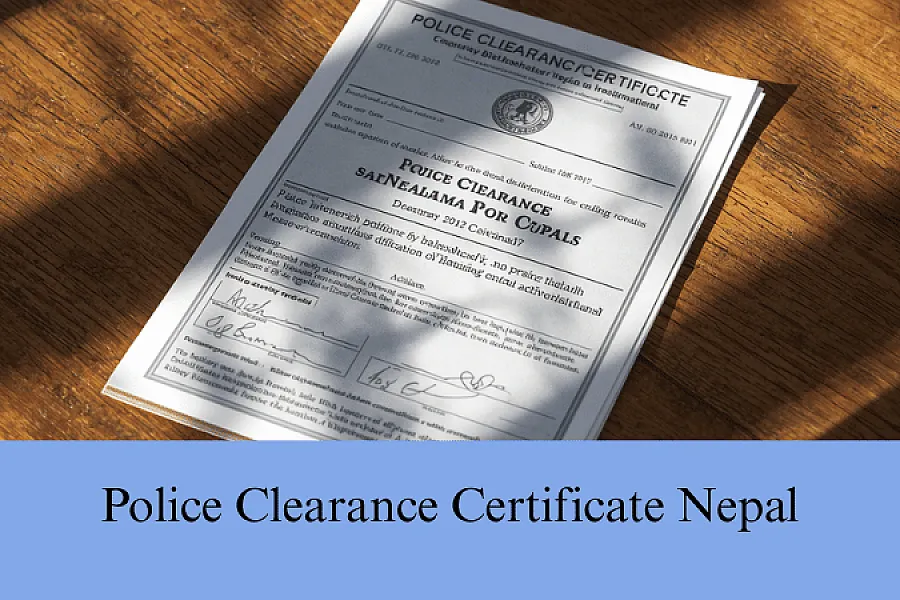
A Nepal Police Clearance Certificate, or PCC, records the result of police character verification for a named applicant. The correct route depends on your identity documents, location, purpose, and whether a foreign authority will receive the certificate.
| Online applicationSubmitted through the official Nepal Police portal | In-person applicationHandled through a District Police Office where available | |
|---|---|---|
| Applicant location | Useful for applicants who cannot visit Nepal | May suit an applicant present in Nepal |
| Submission method | Online form and uploaded records | Office-based submission and verification |
| Authority check | Nepal Police character verification | District police office handling may vary |
| Overseas use | Further attestation may still be required | Further attestation may still be required |
| Current details | Verify portal instructions | Verify office instructions |
The online and in-person PCC routes lead to the same practical question: which submission method and document chain will the receiving authority accept?
A Police Clearance Certificate is a police-issued record of character verification for an applicant. In practical terms, it is used to show the result of a criminal-record check in Nepal for purposes such as foreign employment, visas, immigration, study abroad, or adoption. The certificate is also called a police report or character certificate.
The phrase police report Nepal can cause confusion. A PCC is not a general letter from any private organisation. The relevant process involves Nepal Police and its character-verification function. The available material identifies the Crime Investigation Department (CID) as the issuing authority.
The certificate is purpose-sensitive in practice. A foreign employer, university, immigration authority, embassy, or adoption authority may ask for a PCC in a particular form or with a particular level of freshness. That does not mean every authority follows one identical rule. Ask the organisation that requested the document what it will accept.
If you believe the police record is inaccurate, treat that as a separate issue from an ordinary PCC application. Keep the application factual. Do not assume that an application for a new certificate will correct an underlying record.
Nepal Police CID issues the PCC through its character-verification section, with the available material identifying Police Headquarters at Naxal, Kathmandu. Applicants may use the official online portal, while the current article also identifies a District Police Office route. The receiving office can require current instructions based on the applicant’s circumstances.
The CID character-verification information is available through the Nepal Police CID information page. That page should be checked against the instructions shown when you apply.
For nepal police character verification, the key point is identity matching. The name, citizenship details, passport information, photograph, and other submitted particulars should correspond. A mismatch can create questions even where the applicant has no criminal case.
The exact office handling an application may also matter for an applicant who is in Nepal rather than abroad. Do not assume that a District Police Office will use the same submission method, document copy, or collection arrangement as the online system. Verify the live instruction before travelling.
PCC online Nepal applications are submitted through the official Nepal Police online character-verification portal. The available material describes a form-based application that uses identity records, a passport copy, a recent photograph, and the purpose of the request. The portal’s current instructions control the fields and upload format.
The official application portal is opcr.nepalpolice.gov.np. Use the portal address supplied by Nepal Police rather than an unofficial form or social-media link.
Do not treat a successful upload as proof that the certificate has already been issued. Submission, verification, issuance, downloading, and overseas acceptance are separate points in the process.
The core PCC documents identified in the available material are a Nepali citizenship certificate, passport copy, recent photograph, and the purpose of the request. Applicants abroad may use the online route with their citizenship and passport information. The portal or receiving office may require additional or differently formatted material for a particular applicant.
| Application matter | What the available material identifies | What you should verify |
|---|---|---|
| Identity | Nepali citizenship certificate | Name, date, number, and matching details |
| Travel document | Passport copy | Whether the relevant passport page or copy format is accepted |
| Image | Recent photograph | Current size, format, and upload instructions |
| Purpose | Reason for requesting the PCC | Wording required by the portal or receiving authority |
| Overseas use | Possible MoFA and embassy formalities | Destination-country acceptance and legalisation sequence |
Scan or photograph documents clearly. A blurred copy can delay review or lead to a request for resubmission. The name used in the application should not casually differ from the name in the passport or citizenship certificate.
If your citizenship record, passport, or name has changed, explain the position before filing. A PCC is linked to the applicant’s identity. A document chain that does not explain a variation can be difficult for a foreign employer, embassy, or immigration office to assess.
PCC processing time is not fixed in the supplied material. The earlier guide described online processing as taking a few working days and in-person processing as potentially longer, but verification, document quality, office handling, and applicant category can affect the result. Treat any estimate as non-guaranteed and verify with the receiving office.
Do not book a flight, employment start date, university submission, or embassy appointment solely on an informal estimate. The time needed may include more than police issuance. If the certificate is for another country, you may also need to allow time for Ministry of Foreign Affairs attestation and destination-embassy legalisation.
Ask the requesting authority two separate questions:
Those questions matter because a PCC can be issued on time yet become unsuitable for a particular submission if the foreign authority applies a freshness rule. The available material states that a PCC is often treated as valid for three to six months, while some receiving authorities require one issued within the last three months. These are not universal statutory periods in the supplied material.
PCC freshness is controlled by the receiving authority, so confirm the submission window before relying on a certificate.
A PCC for abroad Nepal submission may require more than police issuance. The available material describes a sequence of obtaining the PCC, securing Ministry of Foreign Affairs attestation, and then completing legalisation by the destination-country embassy. The destination authority should confirm whether every step is required for your particular use.
The relevant sequence is usually described as follows:
Nepal does not issue an apostille under the position stated in the current material. Therefore, do not assume that an apostille request can replace the MoFA-and-embassy route. The Nepal Embassy attestation guidance should be checked for the relevant chain.
Foreign employers and immigration offices can differ. One country may ask for embassy legalisation, while another may focus on its own application rules. The PCC office cannot decide what a foreign authority will accept. That decision belongs to the receiving authority.
The supplied material does not establish a universal fingerprint or biometric requirement for a standard Nepal PCC application. It describes the ordinary application around identity documents, a passport copy, photograph, purpose, and police character verification. A foreign authority may separately request fingerprints on its own form.
That distinction matters. A receiving country’s fingerprint card may support its own criminal-record process rather than Nepal Police’s certificate process. If the instruction comes from an embassy, employer, immigration office, or university, follow that authority’s form and deadline separately.
Do not add fingerprints merely because a third party says they are always required. Ask the authority that requested the PCC whether it needs:
If the portal or police office gives a specific instruction for your application, that live instruction takes priority over a general online explanation.
PCC applications commonly become difficult when identity details, document quality, purpose, or overseas formalities do not align. The available material does not provide one universal error list, but the application structure shows why careful checking matters. Nepal Police may need clarification before character verification can be completed.
Keep copies of the submitted material and any communication from the receiving authority. If the application is rejected or returned, identify whether the problem concerns identity, police verification, document format, or the foreign acceptance chain.
An illustrative applicant living outside Nepal may need a PCC for a visa file. The applicant checks the destination authority’s freshness and legalisation rules, applies through the official Nepal Police portal, and then verifies whether MoFA attestation and embassy legalisation are required before submission.
The applicant should not assume that being abroad removes every Nepal-side formality. The online route may help with submission, but overseas acceptance is a second question. If the destination authority requires an original, attested, or recently issued document, the applicant must plan that chain before the immigration deadline.
An applicant in Nepal may face a different practical choice. The person may investigate the District Police Office route, while another applicant may use the online portal. Neither route should be selected only because a blog describes it as faster. The relevant office and current portal instructions control.
If an applicant has an unusual identity history, a disputed record, or a foreign authority with strict document rules, legal help may be useful. Our team can review the stated purpose and document chain, but we cannot promise issuance, processing time, or acceptance by another country.
Legal help may be useful where a PCC is linked to immigration, adoption, foreign employment, disputed identity information, or overseas attestation. A lawyer can help you organise the facts, identify which authority must answer a question, and prepare a document-handling plan without replacing Nepal Police’s verification decision.
Alpine Law Associates advises and represents clients; it is not Nepal Police, the Ministry of Foreign Affairs, or a foreign embassy. Our team can help you assess the application route and overseas document chain through our contact page.
Where the concern involves a possible criminal record or a disputed police document, you may also review our criminal law practice. That does not change the police authority’s role in issuing or verifying a PCC.
Before submitting, confirm the applicant’s identity details, purpose, document quality, portal or office instructions, and the receiving authority’s acceptance rules. This final review cannot guarantee a result, but it reduces avoidable inconsistency between the Nepal Police application and the later visa, employment, immigration, study, or adoption file.
In short: Nepal Police CID handles the character-verification process identified in the supplied material. The online route may suit applicants abroad, while an in-person District Police Office route may also be available. Documents, processing time, freshness, and overseas attestation depend on the relevant authority. Verify the live requirements before you submit.
If you need advice about pcc nepal, a police report for overseas use, or document handling while you are outside Nepal, contact Alpine Law Associates about our Non-Residential Nepali services. Our team can explain the available options and help you verify the current requirements with the relevant authority.
Disclaimer:
This article is intended solely for informational purposes and should not be interpreted as legal advice, advertisement, solicitation, or personal communication from the firm or its members. Neither the firm nor its members assume any responsibility for actions taken based on the information contained herein.
-thumb.webp)
-thumb.webp)
-thumb.webp)